
Nanjing Jiangning Imperial Silk Manufacturing Museum
- Cathy Shen

- 2 days ago
- 10 min read
If you are visiting museums in Nanjing, the Jiangning Imperial Silk Manufacturing Museum is a wonderful choice. It does not win you over with a single “star object” right at the entrance. Instead, it excels at unfolding the cultural memory of a city slowly and gracefully: one end tied to the historical legacy of the Qing-era Jiangning Weaving Office, the other to the interwoven cultural threads of Dream of the Red Chamber, Yunjin brocade, classical gardens, and paper art.
The museum stands within Nanjing’s historic urban core, on the site associated with the former Jiangning Weaving Office. The location itself is deeply meaningful. The Jiangning Weaving Office was far more than a government bureau that made garments. It was a crucial part of the Qing imperial household system, responsible for court textiles while also embedded in the economic, aesthetic, and political networks of the Jiangnan region. For generations, the family of Cao Xueqin, the author of Dream of the Red Chamber, was closely connected to the Jiangning Weaving Office. The novel’s extraordinary richness and density of detail come from more than literary imagination. Cao likely saw such a world firsthand in his youth: the sheen of silks and satins, the winding spaces of gardens, the intricacies of ritual life, the splendor of a great household, and the shadows cast by decline after glory.
One of the museum’s greatest charms lies in its architectural character. It brings together modern architectural language and the spatial sensibility of a Jiangnan garden while reconstructing features such as Xichi Pond, Lenting Pavilion, Xuanruitang Hall, and Xitang Hall. This is more than a container for cultural relics. It feels like an attempt to recover the very world of life described in Dream of the Red Chamber. The crisp lines of modern architecture meet the corridors, waterscapes, and borrowed views of a southern Chinese garden, producing an effect much like the novel itself: calm on the surface, layered within, and increasingly immersive the deeper you go.
If you read the visitor route as though it were an essay, then the basement level is its true opening chapter. The permanent exhibitions here lead in two directions, one toward Dream of the Red Chamber and the other toward Yunjin brocade. One belongs to literature, the other to craft, yet both ultimately ask the same question: how is splendor made?
I. Begin on the Basement Level: Entering the Dream of the Red Chamber Gallery, and the Deepest Layer of Cao Xueqin’s Memory
For many general readers, Dream of the Red Chamber first appears as a love story centered on Baoyu and Daiyu. In the context of the museum gallery, however, it emerges as something much larger: a family history, a social history, a history of women’s destinies, and a work that transforms personal memory into a literary universe.
Any discussion of Cao Xueqin inevitably leads back to the Jiangning Weaving Office. Among both scholars and general readers, there is broad agreement on one point: the Cao family was deeply tied to the institution, and Cao’s early life experience was inseparable from Nanjing and from the environment of the weaving office itself. The family knew prominence, then confiscation and decline. That dramatic fall from prosperity into ruin forms much of the emotional ground tone of the novel.
That is also why Dream of the Red Chamber writes aristocratic life with such authority. It understands fabrics and food, ritual and gardens, poetry gatherings and household finances. Even a cup, a hanging curtain, or a seasonal banquet is described with the weight of lived memory behind it.
If one were to summarize the novel’s central narrative, it would be this: through the intertwined fates of Jia Baoyu, Lin Daiyu, Xue Baochai, and others, the novel traces the rise and fall of the four great families—Jia, Shi, Wang, and Xue—especially the decline of the Jia household. On the surface, it tells of love and youth. At a deeper level, it reveals the tensions between ritual order and human feeling, the exhaustion of institutions within an elite family, and the way the beauty of youth is gradually worn down by reality.
Jia Baoyu is far more than a conventionally rebellious young man. He is the person within that system who sees most clearly through its illusions. Lin Daiyu is more than a gifted girl who weeps; she is a spiritually aristocratic figure of great self-awareness, sensitivity, and sharpness. Xue Baochai is not simply worldly or polished. She is perhaps the most accomplished, and also the most poignant, product of a world governed by ritual and order.
The “Twelve Beauties of Jinling” function almost like a chart of women’s destinies within the novel. It is a remarkably sophisticated conception: at once a genealogy of characters, a map of fate, an aesthetic catalogue, and a register of tragedy. Yuanchun, Yingchun, Tanchun, Xichun, Wang Xifeng, Shi Xiangyun, Miaoyu, Qin Keqing, Li Wan, Qiaojie, Daiyu, and Baochai are not a neatly arranged gallery of beauties. They are cross-sections of different temperaments, circumstances, talents, and destinies. One of the truly astonishing things about Dream of the Red Chamber is that each woman is more than a supporting figure in the protagonist’s story; each inhabits a complete world of her own. If you view the gallery from this perspective, it becomes easier to understand why the novel still feels fresh today. It is not simply about “a few people from the past.” It is about how human beings are shaped by family, class, gender, and historical time all at once.
The section devoted to the novel’s narrative design especially rewards slow attention. From the opening pages, readers encounter hints such as “true events concealed” and “fiction spoken in rustic words,” reminders that the book is neither a straightforward record nor pure invention. Cao Xueqin’s brilliance lies in the way he fuses lived experience into the structure of the novel, then reshapes it through mythic framing, dreamlike writing, and deliberate self-concealment. In other words, Dream of the Red Chamber does not simply copy life into fiction. It distills life into a form that can both carry hidden meaning and invite retrospective reflection. Truth and fabrication are not opposites here. They are the twin gears that drive the work: truth gives the novel flesh and texture; fiction gives it universality.
So the most valuable thing in the Dream of the Red Chamber gallery is not merely the answer to “Who was Cao Xueqin?” It is a larger question: why was it precisely Nanjing, and precisely the opulent world of the Jiangning Weaving Office, that gave rise to one of the deepest books about rise and decline in Chinese literature? Standing here, you begin to understand that Dream of the Red Chamber did not grow out of a writing desk. It first grew out of life and was then slowly written through pain and memory.
II. Another Technology of Splendor: The History of Nanjing Craft in the Yunjin Gallery
If the Dream of the Red Chamber gallery shows how splendor is remembered, the Yunjin-related exhibitions show how splendor is woven.
Among the museum’s permanent exhibitions, Yunjin is one of the central themes. Public materials mention displays such as “Yunjin Heavenly Garments,” featuring Yunjin textiles and related historical materials. Yunjin is important not simply because it is beautiful but because it can be seen as one of the highest achievements in the meeting of ancient Chinese weaving technology and court aesthetics. The “yun,” or “cloud,” in its name suggests more than softness or lightness. It also evokes brilliant color and layered patterning spread out like clouds at dawn.
The best way to understand Yunjin is to begin with its history. Nanjing has long been a major center of silk weaving, and by the Yuan, Ming, and Qing dynasties, it had developed a highly sophisticated weaving system. In the Qing period, the Jiangning Weaving Office held especially prominent status. Court consumption, ceremonial dress, and imperial gifts all depended on this system. Yunjin, then, was no ordinary local handicraft. It directly served state ritual and palace life. Its magnificence was the result of an entire convergence of institutions, techniques, and aesthetic ideals.
In terms of classification, representative forms of Nanjing Yunjin include kujin, kuduan, and zhuanghua. To put it in less academic and more accessible terms, some emphasize the organization of color, some the structure of the fabric, while others are known for especially rich and elaborate patterns. Zhuanghua in particular often best represents the sumptuous, layered visual effect for which Yunjin is famous. The beauty of Yunjin is woven into the textile rather than applied onto it. Color, gold thread, pattern, and structural design all come into being together, so when you look closely, it does not seem like a flat decorative surface. It feels as though the silk threads themselves have acquired volume and sheen.
The production techniques are perhaps the most captivating part of all. Traditional Yunjin weaving depends on the large wooden jacquard-type loom known as the dahualou and is often summarized through highly complex methods such as “continuous warp and discontinuous weft.” Many people first respond to Yunjin by thinking simply, “How beautiful.” Once they understand more, the response changes to "How on earth was this made?” This is worlds away from the logic of rapid mechanical reproduction. It is a comprehensive craft process that relies on manual expertise, pattern design, the arrangement of colored silk threads, and close coordination during weaving. Public introductions often note that traditional Yunjin weaving typically requires two artisans working together, one above and one below, one lifting and one weaving, in a process that is extraordinarily time-consuming. By modern industrial standards, such efficiency seems almost irrational. Yet this is precisely why Yunjin preserves what is most precious in handcraft civilization: slowness, complexity, and an unwillingness to cut corners.
Seeing Yunjin in a museum also has another advantage: it rescues the craft from the realm of “tourist souvenir” imagination. For many people, the phrase “Yunjin” may conjure up little more than “an expensive fabric.” Once it is placed back into the historical context of Jiangning weaving, however, it becomes clear that it forms part of Nanjing’s urban identity. It is the product of technical history, dress history, ritual history, and art history intersecting with one another. It is more than a material. It is a civilizational order woven into cloth.
III. The Special Exhibition Paper China, Ritual Grace in Bloom: Paper as a Carrier of Ritual, Ornament, and Civilization
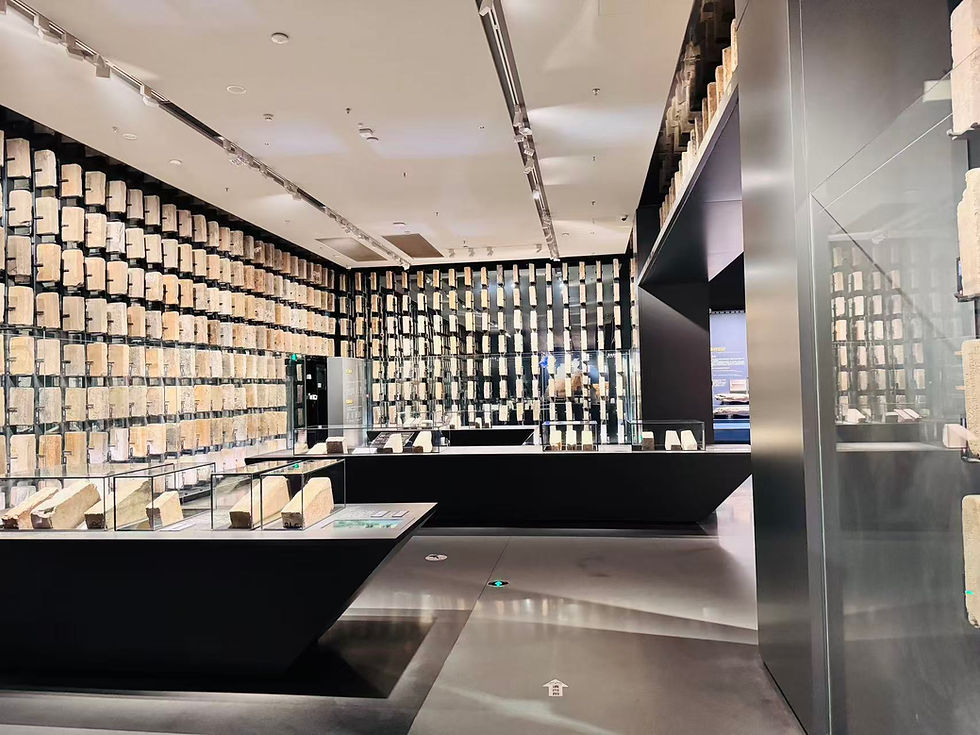
During this visit, the special exhibition Paper China, Ritual Grace in Bloom: An Exhibition of Paper and Pattern Art is especially worth lingering over. The exhibition opened at the Jiangning Imperial Silk Manufacturing Museum on April 16, 2024. Organized around the keywords “paper,” “ritual,” and “flower,” it brings together nearly two thousand related works and research outcomes collected and compiled over a long period, with a focus on Chinese paper art, traditional patterns, and their contemporary transformation.
What makes this exhibition so intelligent is that it does not treat paper merely as a writing material. The history of paper in China can, of course, be traced through the development of papermaking itself—from raw materials and techniques to uses and the emergence of different kinds of paper. Behind all this lies an entire history of technological civilization. Yet if one stops there, paper remains merely functional. This exhibition goes further, showing how paper entered ritual practice, ornament, and everyday aesthetics and gradually became part of the texture of Chinese culture itself.
That is why the phrase “Ritual Grace in Bloom” is so expressive. “Ritual” suggests that paper is never neutral. It has long participated in the ceremonial life of the Chinese people: sacrifice, seasonal observances, weddings, and interior display all make use of paper in one way or another. “Bloom” shifts paper from utility toward aesthetics, opening onto a richer visual world of paper-cutting, paper sculpture, pattern design, and decorative paper art. The exhibition emphasizes Chinese pattern systems, paper-art creation, and interactive display. The patterns that grow out of paper are sometimes linked to the traditional solar terms, sometimes to historical lifelines such as the Beijing–Hangzhou Grand Canal, and sometimes to local customs and folkways. They make it easy for visitors to feel both cultural recognition and emotional resonance.
From the perspective of art history, paper is one of China’s greatest inventions, though also one of its most understated. Bronze seems too solemn, porcelain too dazzling, silk too luxurious; paper often appears plain, almost like a backdrop. Yet in truth, it is paper that quietly connected the spread of knowledge, the circulation of images, folk craft, seasonal decoration, and literati aesthetics. It belongs equally in the scholar’s studio and at the temple fair. It can carry the classics, historical writings, philosophy, and belles lettres; it can also become window cuttings, paper umbrellas, lanterns, and decorative patterns. It is among the lightest of materials, yet it bears an immense cultural weight.
IV. Back on the Ground Floor: The Garden Is No Side Feature, but a Note of Explanation for the Whole Museum
Many museums treat their courtyards as little more than places to pause and rest. At the Jiangning Imperial Silk Manufacturing Museum, the reconstructed garden on the ground floor feels like part of the exhibition itself. Spaces associated with the Jiangnan garden tradition—Xichi Pond, Lenting Pavilion, Xuanruitang Hall, and Xitang Hall—have been recreated within the museum. When people speak of a “full-scale reconstruction,” the point is not simply whether every brick and roof tile makes you feel transported back in time. More important is the recovery of a certain spatial experience: one does not move through the museum in a straight line but enters the narrative gradually, through corridors, water, pavilions, halls, and shifting lines of sight.
This is exactly the art at which the Chinese garden excels. It does not reveal everything at once. It invites understanding through movement. In this sense, it resembles the chapter structure of Dream of the Red Chamber, the layered warp and weft of Yunjin, and the repeated unfolding of patterns in paper art. You begin to see that the museum is guided by a coherent method. It does not break culture into isolated bits of information; it allows literature, craft, architecture, and garden design to illuminate one another. After seeing Cao Xueqin and the rise and fall of the Jia household downstairs, you understand more clearly why the Grand View Garden is far more than a scenic backdrop: it is a spatial projection of an entire way of life and feeling. After looking at the weaving of Yunjin, you can return to the flowers, trees, and architectural textures of the garden and better understand why Chinese aesthetics so often turns human artifice into something that appears almost natural.
A visit to the Jiangning Imperial Silk Manufacturing Museum usually takes around two hours. On the ground floor, there is also a museum shop developed in collaboration with a design studio, and it is well worth a look.


Comments