
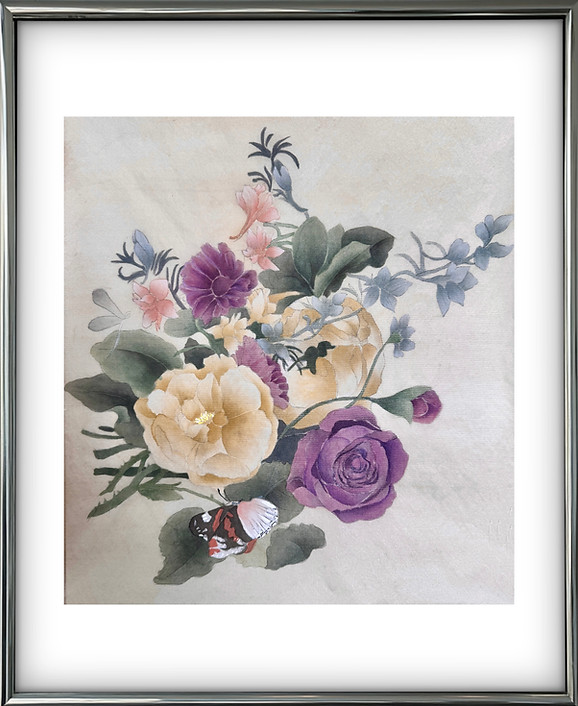
Still Life of Flowers
Cathy Shen, 2026
Chinese Traditional Painting
Theme: Flowers and Birds
Technique: Gongbi (Fine-line)
Material: 100% Matured Silk
You may have noticed that the composition of this fine-line flower-and-bird painting differs from that of a traditional Chinese fine-line flower-and-bird work, with the flowers arranged in a denser and more compact manner. This painting is a reinterpretation of Rachel Ruysch’s Still Life of Flowers on a Table Ledge (1700), created in tribute to the Dutch Golden Age still-life painter. By reimagining the work through the language of traditional Chinese fine-line flower-and-bird painting, I hope to explore a new dialogue between two distinct artistic traditions.
Click here to learn more about Rachel Ruysch.

Still Life of Flowers on a Table Ledge
Rachel Ruysch, 1700
“Three Applications of Alum and Nine Layers of Wash” (“三矾九染”)
“Three Applications of Alum and Nine Layers of Wash” is a traditional coloring method often mentioned in Chinese fine-line painting, especially in fine-line flower-and-bird painting. It emphasizes a process of repeated layering, gradual deepening, and meticulous completion. “Alum” usually refers to an alum-and-glue solution, that is, a preparation made by combining alum with glue, used to treat paper or silk so that colors do not bleed excessively and can also be built up layer by layer more easily. “Washing” refers to coloring processes such as shading, glazing, sectional washes, and blending washes. The so-called “Three Applications of Alum and Nine Layers of Wash” does not mean mechanically applying alum three times and washing nine times; rather, it emphasizes repetition, layering, and gradual progression.
From the perspective of materials, the final effect of color in Chinese fine-line painting depends on the interaction among paper or silk, alum-and-glue sizing, and mineral and plant-based pigments. Silk and sized paper are both delicate materials. If pigments are applied heavily and directly, they can easily appear floating, stiff, muddy, or powdery; if the surface is left completely untreated, the colors can also easily spread, bloom unevenly, and get out of control. For this reason, painters often apply alum moderately at certain stages so that the surface of the painting is slightly “held in,” allowing subsequent layers of color to adhere one by one. In other words, alum is not used to make the picture surface hard but to establish order for the later buildup of color.
From the perspective of the coloring process, “nine washes” embodies one of the most central ideas of coloration in Chinese painting: color is not simply applied but cultivated. In fine-line painting, a sense of refinement usually does not come from laying the color on thickly all at once but from many very light applications. Each pass advances the image only a little: it may slightly deepen the light and shadow, unify warm and cool tones, press down the base of a flower petal a bit, or allow a hint of reflected light to appear along the edge of a leaf. After this process is repeated many times, the resulting color is no longer a flat, rigid patch but a layered color structure with depth, breath, and translucency.
The reason “Three Applications of Alum and Nine Layers of Wash” is so closely associated with fine-line flower-and-bird painting is that this genre especially requires the rendering of textures that are both precise and vividly alive. For example, peony petals must convey both thickness and softness; lotus leaves must show both structural strength and moist luster; bird feathers must appear perfectly ordered without being painted like a specimen. A single application of color usually cannot achieve such complex effects, so they must be built up gradually through repeated washes. With each wash, the painter is not only adding color but also shaping form, not only depicting outward appearance but also adjusting expression and vitality.
However, this technique is not a case of the more washing, the better. A very important sense of measure is involved. If there are too few washes, the color appears floating, thin, light, and unable to stand up; if there are too many, it can become stiff, dull, dirty, and lifeless. This is especially true when the alum-and-glue solution is too heavy: the picture surface can easily become hard, the colors can lose their moistness, and there may even be a risk of cracking later on. Therefore, the core of “Three Applications of Alum and Nine Layers of Wash” is not complexity for its own sake, but disciplined complexity.
Aesthetically speaking, what it pursues is a kind of inwardly contained beauty. Chinese painting often says that color should not interfere with ink, nor ink with color and also values being brilliant without being garish and pale without being weak. “Three Applications of Alum and Nine Layers of Wash” is precisely an important means of achieving this effect. Because the layers of color are built up slowly, the method avoids cheap brightness and instead produces a color quality that is composed, mellow, and restrained. In a good fine-line flower-and-bird painting, the flowers may be brilliant without being harsh, the leaves green without being vulgar, and the white pigments light without seeming flimsy; this sense of stability, moisture, and translucency is in large part related to repeated layered washing.
If we place it within the broader history of Chinese painting, it also reflects a particular conception of time in traditional Chinese art. Freehand painting often emphasizes finishing in one unbroken flow, whereas fine-line painting places greater emphasis on deliberation and cultivation. “Three Applications of Alum and Nine Layers of Wash” means that a painting is not produced in an instant burst, but gradually completed through repeated observation, repeated pauses, and repeated revision. This creative rhythm is itself closely related to the traditional Chinese aesthetic preference for patience, order, restraint, and implicitness.


