

In early 2026, I wrote an essay titled Gentle Firmness: Reconstructing Maslow: The Origins of Aesthetic Need. In it, I reflected on my enduring love for art and art history and on the questions that this passion raised for me amid the intense pace of ninth grade. In China’s secondary school system, ninth grade is the final year of middle school, and nearly every student is preparing for the high school entrance examination. At such a moment, anxiety becomes almost unavoidable. It can be felt among students, among teachers, and throughout the atmosphere of the entire campus.
It was in this context that I found myself returning to one question again and again: is there really a checklist for human growth? And if so, what would it be? Would it consist of standardized test subjects and scores, lists of extracurricular activities for school applications, or a record of every so-called prestigious competition one has entered and won? My answer, in the end, was no. Human growth does not follow a fixed checklist.
From this realization came the initial idea for an exhibition, first conceived under the theme of “Letting Things Grow Naturally.” I wanted to invite peers who share a love for art to create works centered on nature and to bring those works together in an exhibition. At the same time, I hoped the exhibition could become a space for discussing a question that feels deeply relevant to our generation: in an increasingly competitive academic environment, how can young people follow their own inner rhythm? How can we continue to grow naturally, even while moving through systems that constantly measure, define, and pressure us?
Yet as I began developing the project, I encountered a more difficult and practical question. How could an exhibition like this truly help people in the real world? If the pressures we face are shaped by broader social and educational structures, what could a small-scale art exhibition realistically change? Of course, raising the question is itself meaningful, and in fact many educators and ordinary individuals have already recognized these issues and are working to address them. But rather than stopping at a large and abstract critique, I wanted to turn toward something more immediate and concrete: what can we, as young people, do for ourselves? When we face confusion or pressure, how do we learn to adjust ourselves, preserve inner calm, and have the courage to be who we are? And within the art history I love so deeply, might there be experiences, insights, or examples from earlier artists that can still speak to us now?
After thinking about these questions for a long time, I gradually arrived at an answer, which I later wrote about in another essay titled Listening. I came to feel that the answer may lie in the act of listening itself. By remaining attentive to nature and receptive to life, one may still be able to preserve an inner space of one’s own—a place of openness, steadiness, and meaning.
For this reason, the exhibition’s final theme became Sense. Nature remains an essential thread and the primary creative vehicle of the project, but the exhibition is ultimately concerned with something broader: the relationship between perception and the world, between the self and nature, and between inner life and daily experience. As we created our works, we also studied and discussed art and artists together, searching within art history for ways of thinking that might help us respond to the pressures of the present. Through research, I selected three widely known artists—Cézanne, Monet, and Picasso—and looked closely at their artistic journeys in order to explore their connections to perception and to nature. Why was it that, in the later stages of their careers, each of them in different ways moved toward a more natural mode of artistic expression? These discussions form an important intellectual foundation for the exhibition. I hope they will allow both viewers and the young artists involved in the project to arrive at a shared space of reflection.
Building on this, the exhibition also plans to include a live conversation with a contemporary artist. What makes this especially meaningful is that the invited guest is both an artist and an adolescent psychologist. This intersection of identities offers a particularly relevant and contemporary perspective on the exhibition’s theme. When art and psychology meet, when creative practice and the experience of growing up are brought into dialogue, how might we understand Sense in a deeper way, and what might it mean for young people today?
Ultimately, this exhibition does not aim to offer a single answer. Rather, it hopes to provide a way of thinking, a source of support, and a space of reflection for young people as they grow. In an age shaped by rapidly changing technology and an overwhelming flow of online information, it seeks to remind us of the importance of preserving the ability to listen to nature and to remain sensitive to life. It is through this capacity, I believe, that we may learn to face the uncertainties of growth with greater calm and to rediscover our own rhythm and direction in a world that is constantly changing.

Exhibition Theme
That “Sense, Nature” has become such an important theme of this youth art exhibition is precisely because it responds to an increasingly evident condition of contemporary life: in a society overly devoted to efficiency, speed, and results, people all too easily come to treat the world merely as information to be processed, and nature merely as an object to be viewed, named, and used. We have grown accustomed to judging quickly, filtering quickly, moving on quickly, yet we stop less and less often to form an inward connection with the landscape before us, the turning of the seasons, and the growth of grasses and trees. For this reason, “perceiving nature” is not simply a matter of seeing nature, still less of mechanically identifying its outward forms; it is an active, committed process of understanding that engages both body and mind. When people truly enter into nature, the relationship is no longer one of subject and object, but one of mutual interpenetration and awakening.
This active mode of perception matters because it can temporarily release us from the singular logic of efficiency. So much of our looking today is functional: we look at trees to judge the weather; we look at the sky to plan a journey; we look at scenery, often, only to check in and move on. Yet art reminds us at every moment that the world is not only worth being “recognized”; it is also worth being felt. When we truly perceive nature, we begin to notice that morning mist is not an abstract “weather phenomenon,” but a presence that softens the boundaries of space, rendering distant mountains and nearby trees alike more tender and diffuse; we realize that a pond is not a static object, but a living presence continually transformed by wind, light, and time. Such perception reshapes our attention, allowing those of us wearied by life to recover subtlety and an inward quiet.
In these ways, it resonates profoundly with the spirit of Chinese painting. Chinese painting has never taken mere likeness as its highest aim; rather, it regards form as an entrance into expression. Consider, for instance, the deliberate use of blank space. Blankness does not mean absence, nor does it suggest that the painting is unfinished. As an integral part of the painter’s careful composition, that untouched space may signify cloud, mist, or water; or it may correspond to no specific object at all, instead intentionally preserving room for imagination. It is precisely because of such blankness that landscape is not sealed shut, and that the viewer’s gaze and inward state are able to enter the painting. Or consider the principle of shifting steps, changing scenes—behind it lies an active way of seeing. Chinese landscape painting does not require the viewer to stand at a fixed point, observing the world from a single perspective as in linear perspective; on the contrary, it gathers scenes from different angles, distances, and temporalities into the same pictorial field, allowing the act of viewing to unfold slowly, as though one were walking through the mountains. What one sees is not merely nature at a single instant, but an experience of landscape refined and restructured by the painter. For this very reason, Chinese painting does not seek the exact imitation of reality; it seeks instead to infuse nature with human rhythm, vitality, and poetic resonance, so that the image becomes a spiritual space in which one may wander, behold, dwell, and reflect.
If we turn to the history of Western art, we find a similar yet equally fascinating path. Monet, Cézanne, and Picasso, to name three celebrated examples, each gradually loosened the longstanding premise in Western art that painting must faithfully reproduce nature. In Monet’s Impressionist works, strict perspective gives way to subjectively defined color, used to convey mood and atmosphere. What his paintings capture is the human experience of encountering nature—and light—at a given moment.
Cézanne carried this transformation further. He asked: when people look at nature, how do they establish order amid a flux of color and form? Thus, in his Mont Sainte-Victoire series, the mountain is rebuilt. The trees in the foreground, the houses in the middle distance, the mountain and sky beyond no longer submit to the naturalistic demand for outward resemblance; they submit instead to the internal logic of the painting itself. Cézanne is reorganizing how the mountain is understood. Stroke by stroke, he constructs the volumetric presence of natural forms, allowing art to become an independent perceiving subject rather than a mere reflection subordinate to nature.
With Picasso, this transformation becomes even more radical. Les Demoiselles d’Avignon is commonly regarded as the beginning of Cubism because it breaks with an ancient assumption: that an object must be presented from one stable viewpoint. The bodies of the figures are twisted, cut apart, and folded; some faces appear frontal, others in profile; space itself is no longer a continuous realm one can enter naturally, but something compressed and reassembled again and again. Picasso could paint “realistically,” but he consciously refused to treat painting as a mirror of reality. At this point, art ceases to be a mapping of outward forms and becomes a totality governed by its logic. The truth of the image no longer depends on how closely it resembles its object at first glance, but on whether it authentically presents the complex, multidimensional experience through which we come to know that object.
If we follow this line further, we discover that modern art increasingly shifts the core of art from copying nature to reconstructing the perceptual relationship between human beings and nature. Previously, the central task of academic painting had been to render natural objects as accurately as possible: perspective, anatomy, and light were all marshaled so that the image might serve as a near-perfect reflection of reality. Modernism, by contrast, increasingly asks how the artist, through ways of seeing, feeling, and formal language, may actively shape a new whole. Monet, Cézanne, and Picasso all demonstrate this. Later abstraction does so even more decisively. The change here is not one of technical superiority or inferiority but of the very conception of art itself. Nature, too, is no longer an “external object” waiting to be copied but an interactive presence to be perceived.
Thus, from Chinese painting to Western modernism—from Monet to Cézanne, Picasso, and beyond—what truly runs through them is not that art gradually departs from nature, but that it enters ever more deeply into the process of perception. Artists gradually came to recognize that the most essential aspect of nature lies not merely in its contour or appearance but in how it enters human perception, how it alters human feeling, and how it is reorganized through human vision. In both Western modern art and Chinese painting, outward likeness is never the final destination; both seek a deeper truth. At this level, art acquires a life of its own and, in turn, teaches us once more how to encounter the world actively, profoundly, and in full.
II. The venue
One of the earliest, and in many ways most difficult, parts of preparing this exhibition was choosing the venue. When I first began visiting spaces, I was almost immediately drawn to a century-old townhouse in Shanghai’s historic old quarter. Nestled in the heart of a plane tree-lined neighborhood and surrounded by cafés and small independent shops, it carried a distinctly Shanghai atmosphere. More importantly, the preserved wooden staircase, wainscoting, slightly weathered white walls, and the dense canopy of plane trees visible through the steel-framed windows on the second floor all made me feel that the space was in natural dialogue with the theme of the exhibition.
Very quickly, however, practical considerations asserted themselves. The daily rental cost of the house was far beyond our budget, and I had to let go of my first choice, at least temporarily, and reserve a more contemporary venue nearby instead. It was an open, light-filled space with a high window-to-wall ratio, and the plane trees along the street almost completely filled the view outside. I knew quite clearly that it was not an ideal venue for a painting exhibition: the wall space was limited, and that would inevitably constrain the display. But the rent was within reach, and I found it impossible to give up that expanse of green, which seemed almost to spill into the room itself. So I began rethinking the relationship between the works and the space, looking for alternative ways of installing the exhibition. One idea was to hang translucent curtains between the columns, creating temporary surfaces against which the paintings could be shown. In this way, I hoped not only to address the lack of wall space but also to allow the architecture itself to become part of the exhibition’s narrative.
Once the installation plan had begun to take shape, I moved forward with the lease. Then, within just a few days, I learned that our intended exhibition dates had already been booked. It was a deeply discouraging moment, as though all the thinking and adjustments the space had prompted would now have to begin again elsewhere. Fortunately, after several rounds of discussion, the landlord agreed to rent us the townhouse I had originally fallen for at the same price. Looking back, although the process was full of detours, being able in the end to return to the space that had first moved me felt like a kind of belated confirmation. In a way, it became one of the most unexpected and meaningful rewards of the entire preparation process.
III. Design and produce merchandise
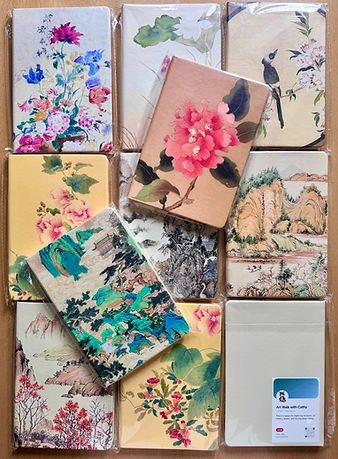
I also produced a series of notebooks and postcards using cropped details from my paintings as the source imagery. On the back, I printed the contact card for my Xiaohongshu series, Art Walk with Cathy—an art history educational video program, details of which can be found on the CLEO page—which also served as a way to promote the series. The postcards were mainly used as small gifts for workshop participants, while the notebooks were sold as merchandise.

Postcards
Notebooks
IV. Coordinate exhibition materials and compile a checklist


VI. Design and produce the conversation backdrop, large hallway posters, and exhibition area posters.
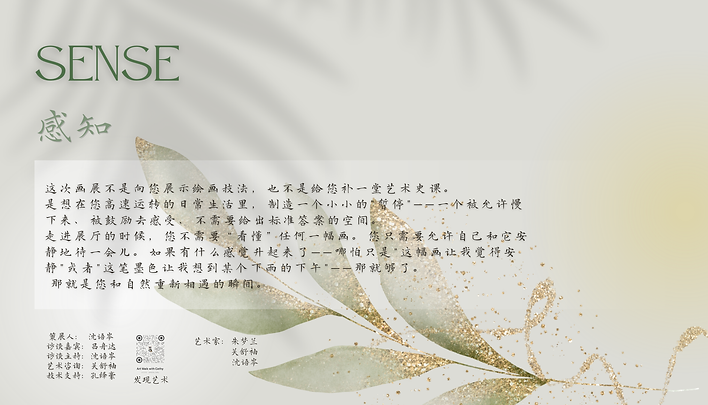
Hallway Poster (180cm*120cm)

Exhibition Area Poster (180cm*120cm)

Conversation Backdrop (120cm*280cm, 80cm*280cm)

Window Poster (80cm*58cm)
VII. Scenes from the site
Installing an exhibition is usually physically demanding work, but having worked on exhibitions of all sizes many times before, I’m already very familiar with the process. This time, there were several artists involved and plenty of people on site to help, so the installation went very smoothly. The only real difference this time was that we set aside a special corner for conversation and arranged a backdrop there. To avoid damaging the landlord’s walls—even though she repeatedly insisted that putting nails in them was perfectly fine and that any holes could simply be patched up after the exhibition—I still tried to use removable adhesive strips for the smaller pieces, reserving nails only for framed works and traditional Chinese hanging scrolls. Now, here’s a tour of the space after we completed the installation.
The work that moved me most in this exhibition was a piece by an 11th-grade senior. With natural, unembellished brushstrokes, she captured the anxiety and pressure she felt while choosing her AP courses. Can you spot this piece in the video below?
Gallery Tour
Compared with the smooth and efficient installation process, the exhibition itself faced decidedly uncooperative weather. Super Typhoon Bavi made landfall on the 11th, and although Shanghai was still about 300 kilometers from the eye at its closest point, this “super giant” was enough to trigger a citywide orange typhoon alert. Residents were advised to secure their windows and doors and avoid going out unless absolutely necessary. Our exhibition, unfortunately, happened to be scheduled for the 11th and 12th.
What surprised and moved me was that, in addition to the students and parents we had invited ahead of time to attend the conversation session, many passersby stopped in throughout the event. Most were adults, but after learning the exhibition's theme, they strongly resonated with its ideas. According to Lu Zhouda, the guest I conversed with for this exhibition, many teenagers with psychological struggles have parents who are dealing with even deeper and more serious issues, and these parents frequently struggle to communicate openly and smoothly with their children, based on his clinical experience.
If this exhibition could serve as a unique window for dialogue, allowing adults, particularly parents, to hear and truly feel the voices of adolescents, that would be an unexpected and deeply rewarding result.


Of course, an occasion this important wouldn’t be complete without my good friend, CLEO. She also came to the exhibition—come take a look at her in person.


IX. Conversation
Guest Bio: Lü Zhouda is a visiting professor at the China Academy of Art and a lecturer in the psychology of painting at Tongji University. An interdisciplinary scholar who bridges artistic creation and psychological research, he graduated from the University of California, Berkeley. With dual perspectives in art therapy and clinical psychology, he is dedicated to exploring the deep integration of art and psychology and to advancing both the academic research and practical application of art therapy.


Conversation Recording