
Nanjing Yunjin (Cloud Brocade) Museum
- Cathy Shen

- Feb 19
- 8 min read
The Nanjing Yunjin Museum is China's only museum dedicated exclusively to cloud brocade. It primarily showcases Chinese ethnic brocade weaving arts, with Nanjing cloud brocade as its centerpiece, and is listed among the "New Forty-Eight Scenic Spots of Jinling."
The museum displays cloud brocade weaving techniques, authentic Ming and Qing dynasty cloud brocade masterpieces, and replicas of ancient Chinese silk textile artifacts. With over 1,500 years of handweaving history, Nanjing cloud brocade expresses a unique aesthetic realm and cultural artistic charm through its distinctive relief and inlay techniques. The museum provides detailed introductions and exhibitions covering the history, varieties and patterns, craftsmanship, and uses of Nanjing cloud brocade. The specific contents are as follows:
History of Nanjing Cloud Brocade
Nanjing cloud brocade is a traditional Chinese silk craft product and a National Geographical Indication product of China. Known as "an inch of brocade is worth an inch of gold," its history can be traced back to the 13th year of Yixi during the Eastern Jin Dynasty (417 CE), when an official bureau specifically managing brocade weaving—the Brocade Bureau—was established in the national capital Jiankang (present-day Nanjing). It has a history of over 1,600 years.
As history progressed, cloud brocade achieved certain development during the Tang and Song dynasties, but more significant technical advances occurred during the Yuan and Ming dynasties.
Yuan Dynasty
Beginning in the Yuan Dynasty, the imperial court established official weaving institutions in Nanjing. Cloud brocade was designated for exclusive imperial use, becoming the primary material for imperial robes, crowns, and consorts' attire. Cloud brocade featuring "gold decoration, color decoration, and peacock feather decoration" was used as royal items and precious gifts for imperial bestowals. Cloud brocade production during the Yuan Dynasty was primarily conducted under the supervision and management of official weaving institutions. The official weaving institutions established in Nanjing at that time managed several thousand households of craftsmen, approximately tens of thousands of people, laying a solid foundation for the development of Nanjing's silk weaving craft.
Yuan Dynasty rulers favored gold brocade and had a preference for decorating silk and wool textiles with gold, which inevitably influenced the design and weaving of silk products. Cloud brocade varieties such as "treasury gold" (kujin) and "woven gold brocade and satin" evolved from Yuan Dynasty gold brocade. Using gold to decorate silk textile patterns became an important decorative characteristic of Nanjing cloud brocade. The Yuan Dynasty created many elegant interlocking floral patterns, various cloud patterns, and auspicious designs, providing rich references for cloud brocade pattern design in the Ming and Qing dynasties.
Ming Dynasty
During the Ming Dynasty, Nanjing's cloud brocade weaving techniques became increasingly mature and refined. Zhuanghua (decorated flower) textiles were the most representative products of Ming Dynasty Nanjing silk weaving. Zhuanghua textiles originally involved cutting out flower patterns and adding colors on satin-ground jacquard fabrics, and later this color-weaving technique was applied to fabrics of different textures and weave structures, including gauze, leno, silk, thin silk, and velvet. Their distinctive feature is "cutting flower patterns and adding colors," with rich color variations—each flower differs in color—achieving effects that are both diverse and unified. Additionally, the private brocade and satin weaving industry flourished during the Ming Dynasty.
Qing Dynasty
In the second year of Shunzhi (1645 CE), the Qing court established the Jiangning Weaving Bureau, bringing new development opportunities for Nanjing cloud brocade. During the Qing Dynasty, Nanjing cloud brocade presented an unprecedented prosperity. During the Qianlong and Jiaqing periods, Nanjing's silk weaving industry reached its peak, with over 30,000 looms and more than 200,000 male and female weavers within the city alone—approximately one-third of the entire city's population.
In terms of technique, Qing Dynasty Nanjing cloud brocade inherited Ming Dynasty achievements and developed even more maturely. Particularly in gold thread production technology and gold thread quality, there were significant improvements, and techniques for decorating textiles with gold became more varied. Compared with Ming Dynasty brocade and satin, Qing Dynasty products were more delicate and exquisite. During the Kangxi period, Song Dynasty regular brocade was often imitated, with gold threads as fine as hair. The Yongzheng period emphasized color matching, with elegant compositions, refined color combinations, and a distinctive style. During the Qianlong period, while imitating Han and Tang Dynasty brocade styles, Western floral patterns and weaving methods were absorbed, promoting new changes in brocade patterns.
Present Day
Today, only cloud brocade still maintains its traditional characteristics and unique techniques, having preserved traditional jacquard wooden loom weaving. This traditional handweaving technique, which relies on human memory for weaving, still cannot be replaced by modern machines.








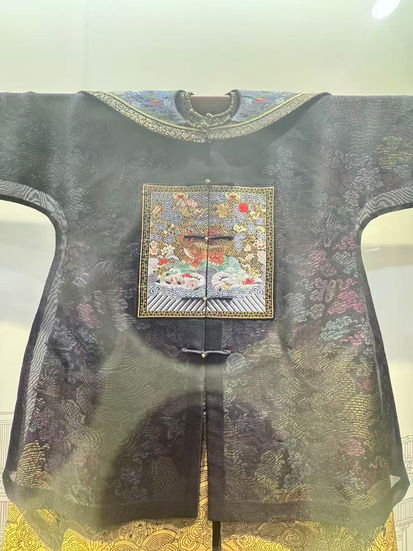


Characteristics of Nanjing Cloud Brocade
Among ancient silk textiles, "brocade" (jin) represents the highest technical level of weaving. Cloud brocade is named for its brilliant, radiant colors as beautiful as clouds in the sky. It uses exquisite materials, features meticulous weaving, beautiful patterns, gorgeous brocade designs, and an elegant style. Developed on the basis of inheriting excellent traditions from past dynasties' brocade weaving, it also incorporates valuable experience from various other silk weaving crafts, reaching the pinnacle of silk weaving artistry.
Cloud brocade is honored as the "crown of all brocades," representing the highest achievement of Chinese silk weaving, concentrating the essence of Chinese silk weaving techniques, and serving as a brilliant crystallization of Chinese silk culture.
Nanjing cloud brocade is a culmination of brocade weaving arts from all previous dynasties and ranks first among China's Four Famous Brocades. The wooden loom zhuanghua handweaving technique of Nanjing cloud brocade represents the highest level of ancient Chinese brocade weaving. This technique involves complex procedures, including over a dozen steps such as "setting up the loom, threading the heddles, threading the selvedge, finding broken ends, joining threads, drawing the pattern, winding the weft, practicing with the shuttle, throwing the shuttle, cutting patterns and threading tubes, zhuanghua color matching, and weaving the weft"—exceeding one hundred processes in total. It takes as little as two to three months, or as long as four to five years, to finally weave a piece of Nanjing cloud brocade.


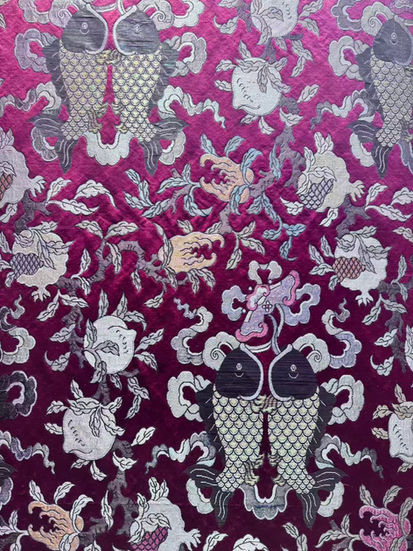






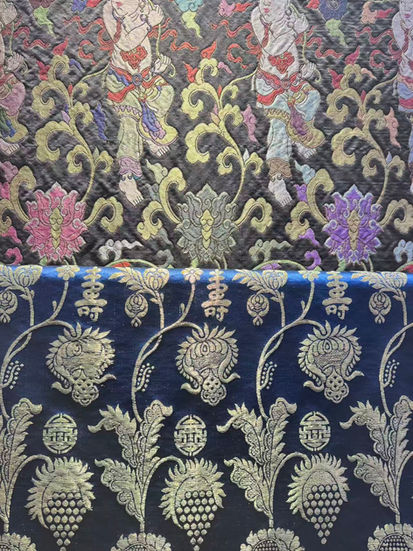


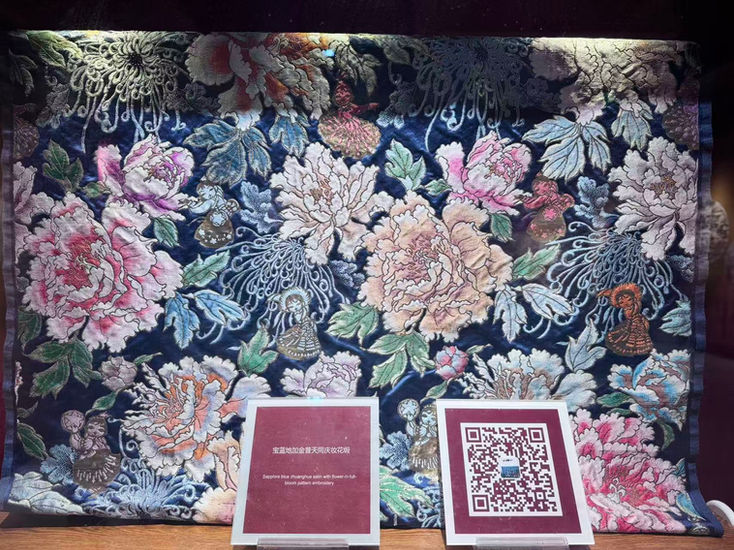


Craftsmanship of Nanjing Cloud Brocade
Cloud brocade weaving techniques are superb, refined, and creative. The key characteristics are "continuous warp with discontinuous weft" and "cutting flower patterns and adding colors."
The Great Flower Tower Wooden Loom
The loom used for cloud brocade is called the Great Flower Tower Wooden Loom (Dahuolou Muzhiji). It measures 5.6 meters long, 1.4 meters wide, and 4 meters high, with a highly scientific and rational design. Each loom is divided into upper and lower floors. During weaving, the pattern-drawer on the upper floor raises the warp threads according to the pattern draft requirements, while the weaver below adds gold and applies colors to the patterns on the fabric, throwing the shuttle to weave the weft.
Completing a single weft thread requires the small weft tubes to be alternately passed through multiple times, freely changing colors—an extremely complex process. With two people cooperating above and below, only 5-6 centimeters can be woven per day, hence the ancient saying "an inch of brocade is worth an inch of gold."
The person sitting on the upper level is called the "pattern-drawer" (zhuaihua gong), who simply needs to draw and lift according to the thread sequence—comparable to typing on a computer keyboard. The person sitting below is called the "weaver" (zhishou), who uses the "continuous warp with discontinuous weft" technique (where the weft is composed of an indefinite number of colored silk segments spliced together), cutting patterns and weaving in sections, adding gold and applying colors, to weave the colorful cloud brocade. The weaving surface before them is comparable to a computer display screen. This craft still cannot be replaced by machines.
Pattern-Picking and Cord-Knotting
Tiaohua jieben (pattern-picking and cord-knotting) is another major craft characteristic of cloud brocade. Due to the complexity of the patterns, weaving one inch of brocade often requires a pattern draft one foot long. To put it visually, pattern-picking and cord-knotting is like computer software: using cotton-based threads to encode the pattern designs and colors according to the most ancient cord-knotting method, creating a program that is then mounted on the loom for weaving.
When the upper-floor pattern-drawer draws the pattern, it's comparable to typing on a computer keyboard; the weaver below works according to the weaving surface, comparable to a computer screen display, then adds gold and applies colors. The entire process is wonderfully ingenious, full of magical qualities, and still falls within the scope of state secrets.
Gold and Silver Incorporation
In addition to "continuous warp with discontinuous weft" and "pattern-picking and cord-knotting," incorporating gold and silver threads is another major characteristic of cloud brocade. The textiles appear magnificently elegant and resplendently golden, satisfying the needs of imperial royal items.


Categories of Nanjing Cloud Brocade
Cloud brocade has four main varieties: Woven Gold (zhijin), Treasury Brocade (kujin), Treasury Satin (kuduan), and Decorated Flower (zhuanghua). Each major category contains numerous sub-varieties. The structure of cloud brocade currently features satin weave as the primary type, along with gauze, leno, and twill weaves. The Ming Dynasty had even more varieties; zhuanghua alone included gauze, leno, silk, thin silk, velvet, and pongee. The patterns and colors of cloud brocade are numerous beyond count.
Woven Gold (Zhijin, also called Kujin)
This refers to silk textiles with patterns woven entirely in gold thread, sometimes using silver thread (called kuyin). The overall appearance is brilliantly golden and magnificently splendid. The patterns are mostly small designs to fully showcase the luster of the gold thread. It was tribute exclusively supplied to the imperial household.
Treasury Brocade (Kujin)
This is a jacquard silk textile with various patterns woven in gold or silver thread on a satin ground. It is often conflated with "woven gold" but places greater emphasis on combining gold and silver threads with colored silk. It is divided into types such as "two-color gold treasury brocade" (using both gold and silver thread) and "colored flower treasury brocade" (adding two to three colors of silk). Patterns are mostly small flowers with relatively fixed colors, and the reverse side is smooth and flat.
Treasury Satin (Kuduan, also called "flower satin" or "imitation satin")
This is a jacquard textile featuring self-colored patterns or ground-and-pattern in two colors on a satin ground. The patterns do not use gold or silver thread; instead, the designs are formed through weft thread coloring. Based on decorative techniques, it can be divided into self-colored pattern treasury satin (single color), ground-and-pattern two-color treasury satin, gold-decorated treasury satin (with partial gold), gold-and-silver dot treasury satin, and color-decorated treasury satin (with partial colored silk). Patterns include "bright flower" (raised on the surface) and "hidden flower" (flat without a raised pattern) distinctions.
Decorated Flower (Zhuanghua)
This is the most complex in weaving technique and richest in color among all cloud brocade varieties, representing the highest technical level of cloud brocade. Its core technique is "cutting pattern section weaving" (continuous warp with discontinuous weft), using weft tubes wound with different colored threads to excavate and weave localized pattern areas. Color matching is free and unrestricted by weave structure—a single piece of textile can use dozens of colors and achieve color gradation and layering effects.
Zhuanghua is often used for weaving dragon robes and decorated flower satin with large-scale patterns. It still cannot be replaced by machines today. There are sayings like "an inch of gold for a decorated flower" and "view a decorated flower on horseback" (meaning the patterns are so large you need to ride past to see them fully).




Visiting the Museum
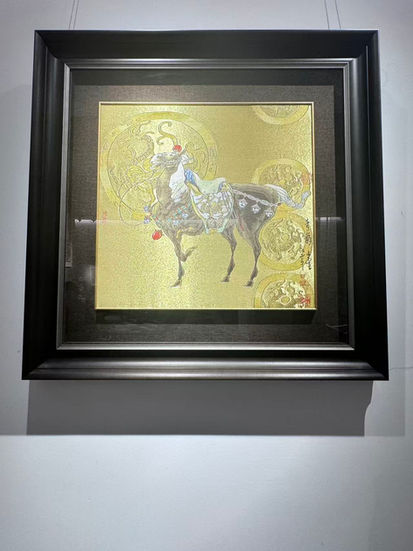
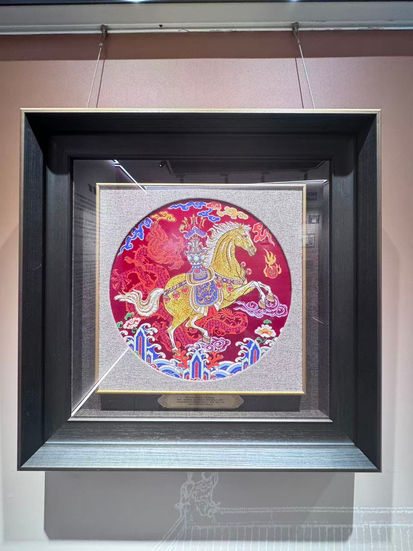
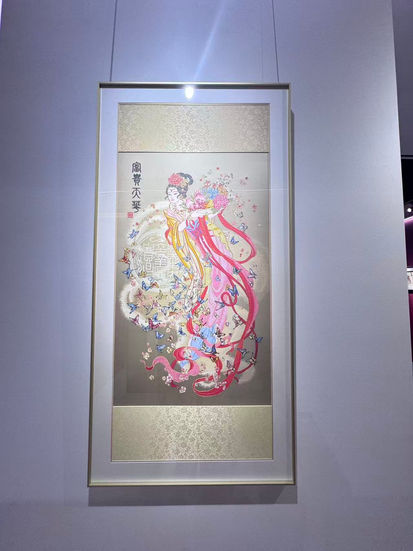
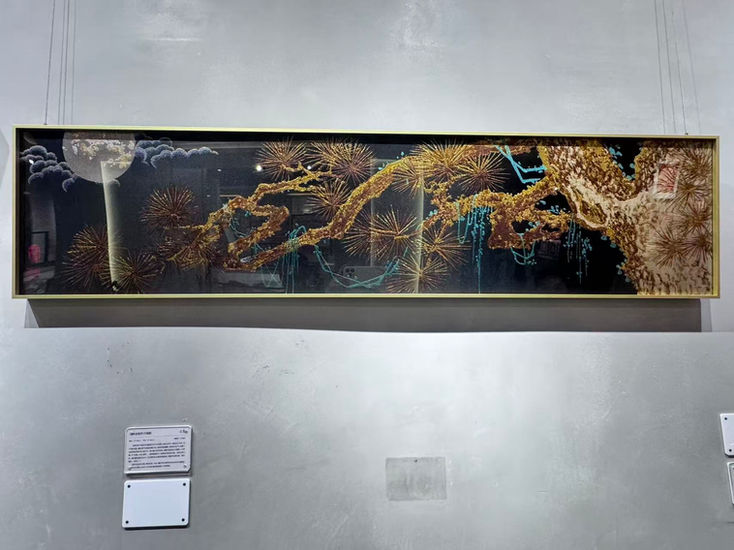
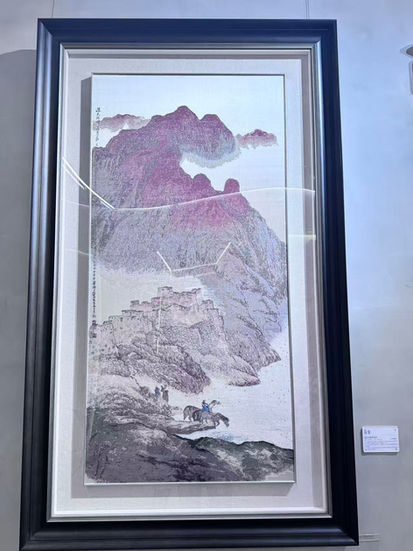
The first floor of the Yunjin Museum is the cloud brocade product sales area, while the second floor displays various loom models and physical demonstrations of cloud brocade weaving techniques. Admission is free, and touring the entire second-floor exhibition area takes approximately one hour. The first floor also features displays and sales of cloud brocade artworks and crafts—even without purchasing, they are well worth appreciating.






















Comments