
Jadeite is "jewelry," and Hetian Jade is "culture"?
- Cathy Shen
- Mar 21
- 5 min read
Have you ever felt puzzled while wandering through a museum? The jade artifacts in the display cases—warm, lustrous, and archaic in form—look nothing like the vivid, dripping-green jadeite bracelets in the jewelry shops outside, yet both are called "jade" (yù). Were the jade pendants worn at the waist by ancient scholars truly the same thing as the jadeite bracelet on your grandmother's wrist today?
The answer is no.
The question sounds simple, but behind it lies thousands of years of civilizational history, an underappreciated tale of trade, and an aesthetic debate that is still very much alive. Let's dig in.

I. Jade and Jadeite: Similar Names, Entirely Different Worlds
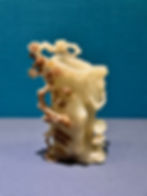
In the Chinese linguistic context, "jade" (yù) is an extraordinarily broad concept—any smooth, fine-textured stone of reasonable hardness could be called jade by the ancients. From the perspective of modern mineralogy, however, jade and jadeite are two entirely different minerals.
What we generally call "jade" refers to Hetian jade (Hotan jade), the representative of nephrite, composed primarily of tremolite, with a Mohs hardness of roughly 6 to 6.5. Its luster is understated and inward; its texture is fine and smooth, like congealed fat. The predominant colors are white, celadon, yellow, and black, with the finest grade known as "mutton-fat white jade"—held in the palm, it feels warm and almost alive.
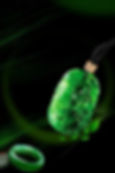
Jadeite, by contrast, is a durable jade (jadeite pyroxene), with a slightly higher Mohs hardness of about 6.5 to 7. Jadeite is rich in color—green being the most prized—with a pronounced glassy luster, high translucency, and strong visual impact that commands attention from across a room.
The aesthetic temperaments of the two could not be more different: Hetian jade is like a refined, gentlemanly scholar—one must quiet the mind to appreciate it; jadeite is like a woman dressed in all her finery—impossible to look away from at a glance. To put it in a single sentence: the beauty of Hetian jade must be cultivated; the beauty of jadeite needs no explanation.

II. What Kind of "Jade" Was Used in Ancient Chinese Artefacts?
China's history of jade use stretches back eight thousand years to the Neolithic era. Long before the invention of writing, jade became a medium for communicating with the heavens and the spirits, as seen in the pig-dragon jade carvings of the Hongshan Culture and the exquisitely worked jade cong tubes of the Liangzhu Culture.
The protagonist of these ancient jade artifacts was invariably Hetian jade—especially the nephrite produced in the Hetian region of Xinjiang. From the Shang and Zhou dynasties onward, Hetian jade travelled east along the long "Jade Road" to reach the desks and waistbands of Central Plains aristocrats. Local jade varieties were also used across different regions—Xiuyan jade from Liaoning, Dushan jade from Henan, and Lantian jade from Shaanxi—each with its applications, though none matched Hetian jade in cultural prestige.
In ancient China, jade was never merely a lovely stone. Confucius mapped the qualities of jade onto the virtues of the exemplary man (junzi), proposing that jade embodies five virtues—benevolence, righteousness, wisdom, courage, and purity—and that wearing jade was the outward expression of a gentleman's self-cultivation. "A gentleman does not part with his jade without reason"—jade was a symbol of character, a mark of status, and a vessel of ritual propriety.
It is for precisely this reason that Chinese jade artifacts throughout history were predominantly ritual objects, personal ornaments, and scholars' pieces—cong, bi discs, gui tablets, pendants, and plaques—all centered on symbolism and moral metaphor rather than sheer visual splendor. This is fundamentally different from the consumer logic of today's jewelry shops.

III. Where Did Jadeite Come From—and How Did It Rise to Prominence?
The story of jadeite begins in Myanmar.
Jadeite is produced primarily in the Hpakant mining region of northern Myanmar; China itself produces none. Although jade trade between China and Myanmar existed as far back as the Ming dynasty, jadeite did not enter China on a truly large scale until the late Ming and early Qing dynasties. Before that point, China's long jade history had virtually nothing to do with jadeite.
The rise of jadeite is inseparable from one name: Empress Dowager Cixi. The de facto ruler of the late Qing dynasty was nearly obsessional in her passion for jadeite—her jadeite jewelry, jadeite ornaments, and even the jadeite watermelons buried with her after death were each worth a fortune. The imperial family's enthusiasm swiftly ignited a jadeite craze among the upper classes, completing jadeite's transformation from an exotic foreign stone into aristocratic jewelry.
Simultaneously, with the rise of Hong Kong's modern jewelry industry, Hong Kong merchants systematically introduced jadeite to international markets, packaging it under the name "Imperial Jade" as the "gemstone of the East" and successfully breaking into high-end Western jewelry circles. This series of commercial maneuvers laid a solid foundation for jadeite's dominance in China's modern consumer market.

IV. Why Do Modern Consumers Buy More Jadeite?
The answer is not as simple as "Jadeite looks better." It is the result of multiple converging factors.
In terms of visual appeal, jadeite is naturally better suited to the jewelry market. Its vivid colors, high translucency, and strong luster produce stunning visual effects when fashioned into bracelets, ring faces, and pendants—especially captivating under jewelry-store lighting. Jadeite instinctively draws ordinary consumers without any aesthetic training. Hetian jade's beauty, by contrast, is restrained and reveals itself gradually—the experience of jade "growing warmer and more beautiful the more you handle it" demands a level of connoisseurship that confines it largely to circles with a cultivated appreciation for collecting.
In terms of cultural identity, Hetian jade embodies the philosophical traditions of the literati and the ritual culture of the imperial court, positioning it more as a scholar's piece, decorative object, or collector's item than as everyday fashion jewelry. Jadeite, on the other hand, has successfully completed the transition from "cultural symbol" to "fashion jewelry," aligning far more closely with the expectations of modern urban consumers.
In terms of origin and supply, the situation is rather ironic. Top-grade Xinjiang Hetian seed jade (zi liao) is extremely scarce and has been nearly exhausted recently. The vast majority of what circulates in the market as "Hetian jade" is in fact Qinghai material, Russian nephrite, or other broadly classified nephrites of highly variable quality. Jadeite, though equally dependent on a single source in Myanmar, has a far more mature extraction and processing supply chain, with clearly differentiated product tiers that can simultaneously serve the high-end collectors' market and the mass jewelry market—a supply structure far more stable than Hetian jade's.
In terms of industry chain and commercial marketing, jadeite benefits from a complete closed-loop ecosystem—from mine extraction and rough-stone trading to cutting, processing, and retail branding—backed by decades of brand-building and market promotion by jewelers. Jadeite's consumer culture has become deeply ingrained. Hetian jade's promotion, by contrast, has long relied on literati circles and the collectors' market, with weak mass-market communication. Adulteration and counterfeiting plague its pricing structure, significantly eroding the confidence of ordinary consumers.

In Summary
Jade and jadeite are two different minerals, two different aesthetics, and two entirely different cultural narratives.
Hetian jade took eight thousand years to grow, within the soil of Chinese civilization, into a philosophical system centered on the exemplary man, ritual propriety, and moral character. Jadeite took fewer than three hundred years—riding the dual tailwinds of imperial glamour and modern commerce—to become the leading player in today's jewelry market.
Neither is superior to the other. If you are drawn to the restrained, understated, deeply layered beauty of Eastern aesthetics, Hetian jade is worth a lifetime of slow appreciation. If you seek the vivid color and striking visual presence of something meant to be worn and admired, jadeite is the more direct choice.
The one thing to be wary of is conflating the two—because understanding jadeite as "the jade of ancient China" is a bit like treating a cappuccino as Tang dynasty tea. The difference isn't merely one of flavor. It's an entire era.