
WHYGARDEN
- Cathy Shen

- Dec 27, 2025
- 5 min read
When we were organizing the "Collision and Fusion" themed exhibition, we conducted a survey asking respondents which direction of artistic activities interested them most. "Everyday aesthetics" scored particularly high. So today, I am visiting a home art gallery called "WHYGARDEN."
WHYGARDEN is an original home furnishing brand founded in 2020, focusing on natural art and international design. Its product range covers furniture, lighting, and other series, with its official website at www.whygarden.com. Designer Meng Ye and his team spent two years creating WHYGARDEN. In the brand name, "WHY" represents the spirit of questioning and innovation in design, while "GARDEN" symbolizes the never-withering creative garden in the designer's heart, emphasizing a living aesthetic of freedom, relaxation, and poetry. With "natural art" at its core, the brand integrates natural elements such as auroras, ocean waves, and plants into its designs, pursuing a balance between functionality and artistry. Its goal is to provide personalized home furnishings that allow young people to express their independent personalities.
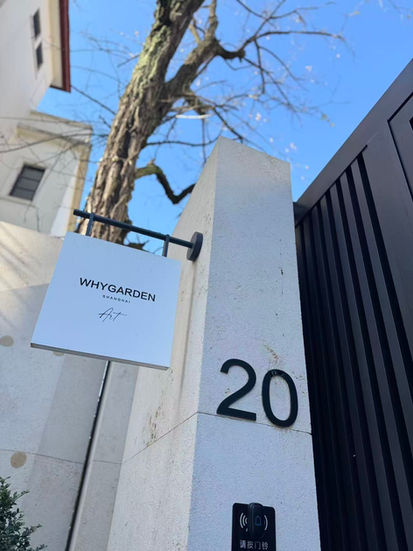
For details, those interested can search on their official website. This blog only discusses my experience visiting the WHYGARDEN Home Art Gallery. This three-story Western-style house, tucked away in an old lane in Shanghai's Huangpu District, has been painted cream white, fitted with pure black steel doors and windows, and complemented by green plants in the small courtyard, outdoor chairs, and awnings—all giving an immediate Instagram-worthy impression.



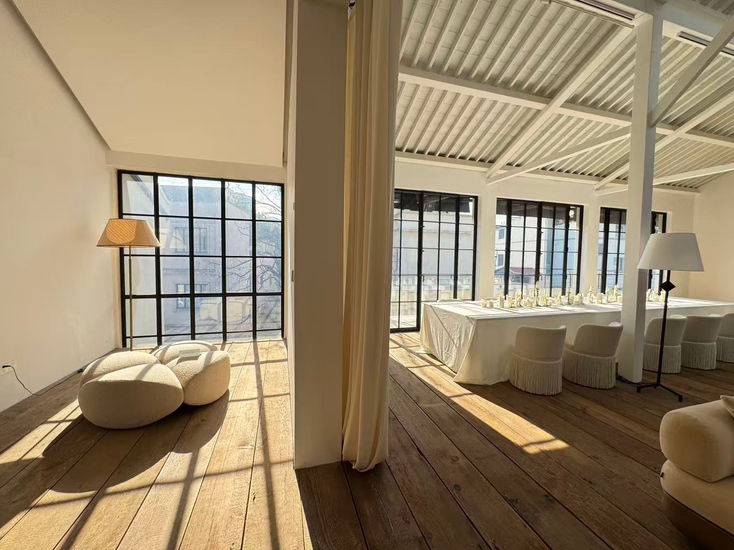
The designer certainly has his own considerations and philosophy, but as a visitor, the furnishings here evoke a sense of minimalist style. The large solid wood floor panels are presented in their raw, unpolished form, and the sparse green plants also appear in their natural, untrimmed state, creating a sense of natural style. The high ceilings, original sloped roof, all-white walls throughout the house, simply shaped furniture, faded light khaki patterned rugs on the floor, cream-colored curtains, tablecloths, staircases, and pure white candles are all filled with Nordic characteristics. If I had to identify an artistic style to interpret this space, the extensive use of white space and color coordination would make me more inclined to classify it as minimalism.
On Minimalism:
Minimalism, as a formal art movement, emerged in the United States in the 1960s and developed primarily in New York. Its origins can be traced back to the 1950s, when a group of young artists grew weary of the excessive emotional outpouring and personal expression in Abstract Expressionism and sought a calmer, more objective artistic language. By the 1960s, Minimalism had become an independent artistic movement, and in the following decades, it continuously expanded its influence from fine art to design, architecture, music, and even lifestyle.
The birth of minimalism is closely related to various intellectual currents. From a Western perspective, Minimalism initially emerged as a direct response to Abstract Expressionism, rejecting the emotional catharsis and personal mythology inherent in Jackson Pollock's style. Second, it inherited the rational legacy of "form follows function" from the Bauhaus design school. Additionally, Russian Constructivism's exploration of geometric abstraction provided important visual resources. However, minimalism was equally influenced by Eastern philosophy, particularly the spiritual core of "less is more" in Japanese Zen aesthetics, the appreciation of imperfect beauty in Wabi-sabi philosophy, and the abundance within emptiness embodied in the "blank space" tradition of Chinese painting—all of these Eastern wisdoms left deep imprints in the bloodline of minimalism.
Minimalism exhibits several distinctive formal characteristics. First is geometric simplification: artists use only the most basic geometric shapes—squares, rectangles, circles, and straight lines—and discard all decorative elements, allowing form to return to its purest state. Second, there is repetition and seriality: identical units are arranged in regular patterns, which provide the production an industrialized, depersonalized feel. Third is the authenticity of materials: Minimalist artists are passionate about revealing the texture and properties of materials themselves, often using industrial materials such as steel, aluminum, glass, concrete, and fluorescent lights rather than traditional art materials. Finally, there is spatial interaction: artworks are no longer isolated objects but engage in dialogue with the exhibition space, and viewers' movement through the space continuously changes their perception of the work.
The essence of minimalism is a philosophy of subtraction. It believes that by removing superfluous elements, essence can be revealed; by abandoning elaborate decoration, what truly matters can surface. It is not merely an artistic style or design language but a way of seeing the world—finding tranquility amid complexity, discovering depth in simplicity, and experiencing abundance in emptiness. This philosophy is perhaps why minimalism, born sixty years ago, has shown ever greater wisdom and charm in today's age of information overload and material excess.
Common Color Palettes in Minimalism
The use of color in minimalism similarly follows the principle of "less is more," forming several classic color systems.
The most representative is the black-white-gray system, which serves as the eternal foundation of minimalism. Pure white symbolizes purity, space, and infinite possibility, making it the most common dominant color in minimalist spaces. Ivory and off-white maintain brightness while adding a touch of warmth and softness. The gradation from light gray to medium gray to dark gray provides rich yet restrained layers: light gray conveys balance and modernity, medium gray gives an impression of stability and professionalism, while dark gray contains power and refinement. Pure black, as the ultimate contrasting color, brings absolute, dramatic visual tension. This achromatic system constitutes the purest visual language of minimalism.
Earth tones represent another important color direction in minimalism, injecting natural warmth into austere minimalist spaces. Colors such as beige, sand, taupe, and warm brown derive from natural elements like earth, rock, and wood, sharing deep roots with Japanese Wabi-sabi aesthetics. These colors are simple without being monotonous, warm without being cloying, and particularly suited for creating minimalist spaces with an organic feel and Eastern Zen sensibility.
Minimalism occasionally uses a single chromatic color as a visual focal point, but such use is extremely restrained. Whether it's a hint of deep navy blue, a hint of steady dark green, a trace of striking mustard yellow, or a block of powerful dark red, these accent colors typically occupy only a small proportion of the picture or space, yet they serve as the finishing touch. In color application, minimalism usually follows the "60-30-10 rule": approximately 60% of the area uses the dominant color (usually white or light gray), 30% uses secondary colors (dark gray, wood tones, etc.), and only 10% is reserved for accent colors. Minimalist color schemes discourage the use of multiple chromatic colors, large-scale use of highly saturated colors, and complex gradients and patterns.
Looking back at the photos and videos I took during my visit, can you sense how the principles of minimalist color schemes have been applied? Sixty percent cream white and light khaki (walls, rugs, curtains, tablecloths, lighting fixtures, coffee table surfaces, most sofas, bedding, etc.), thirty percent earth brown (bookshelves, floors, table legs, bar counter, floor lamp stands), and ten percent matcha green (a few sofas, green plants)—isn't the combination just right? I greatly appreciate the introduction of matcha green, rather than a single chromatic color with higher saturation and more visual impact, because it is more suitable for everyday home settings and adds natural vitality to the overall space.














The WHYGARDEN gallery has been set up as a space for exhibiting home art. Admission is free, but it only accepts a very limited number of visitors each day. Online reservation is required, and each group of visitors may stay for a maximum of one hour.


Comments