
Tank Shanghai
- Cathy Shen

- Nov 30, 2025
- 4 min read
Tank Shanghai was established in March 2019 and is located at No. 2381 Longteng Avenue, Xuhui District. Collector Qiao Zhibing founded the institution in the area that originally stored oil tanks at Longhua Airport, which was decommissioned in 1966. In 2025, it was ranked 9th on the international authoritative art media ARTnews' list of "25 Best Museum Buildings of the Century."
The institution has transformed five abandoned aviation oil tanks into an integrated art ecosystem space that combines exhibition spaces, performance venues, and public landscapes, covering an area of approximately 60,000 square meters. OPEN Architecture designed the renovation. As a nonprofit organization, it continuously explores the interactive relationship between contemporary art and urban space through art exhibitions, public education, and cross-disciplinary collaborative projects.


Currently on display are three art exhibitions:
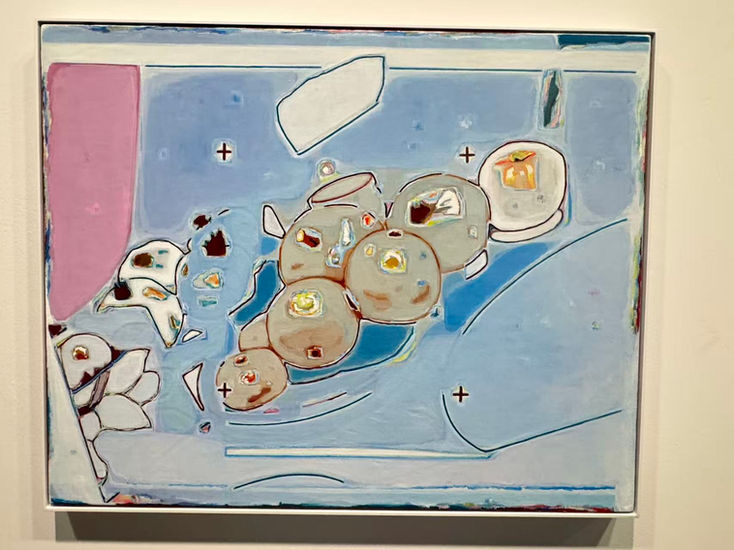
Tang Yongxiang's "People Tree Feet" solo painting exhibition
Xiao Jiang's "People Looking at the Scenery" solo painting exhibition (Exhibition period: November 11, 2025, to February 8, 2026)
Jean-Marie Appriou's "Cosmic Clock" art exhibition (Exhibition period: November 11, 2025, to March 8, 2026)


“People Tree Feet”
As a painter, Tang Yongxiang adheres to the process of "overpainting" his works: each day, he enters his studio and, through a set of prescribed repertoires of brushwork gestures and coloring decisions, returns to canvases that were "paused" in their making from the previous workday. This cycle repeats daily, accumulating across years. with the painter's set of seemingly calculable and near-uncompromising operational actions: the extraction of images from "nearby" his life, the direct use of raw pigments, the application of uniform cross-hatched brushstrokes, and so on. Eventually, a painting is permanently "paused" and released from the artist's studio into broader moments of display, viewing, and critique.
From a broader, systematic perspective, an artist's painting embodies the relationship between the artist and a certain "painting machine"—a relationship comparable to a standoff, or duel, between a computer game player and the machine. This relationship serves as an allegory of control and counter-control, the computable and the incomputable, execution and counter-gaming When Tang Yongxiang pressed "pause" upon entering Beijing's contemporary Chinese painting scene in 2007, he suspended his specific method of realist painting for several years and later reestablished his formatted overpainting. This represents a subjectively initiated algorithm—an act-moment of artistic hacking and critique.




"People Looking at the Scenery"
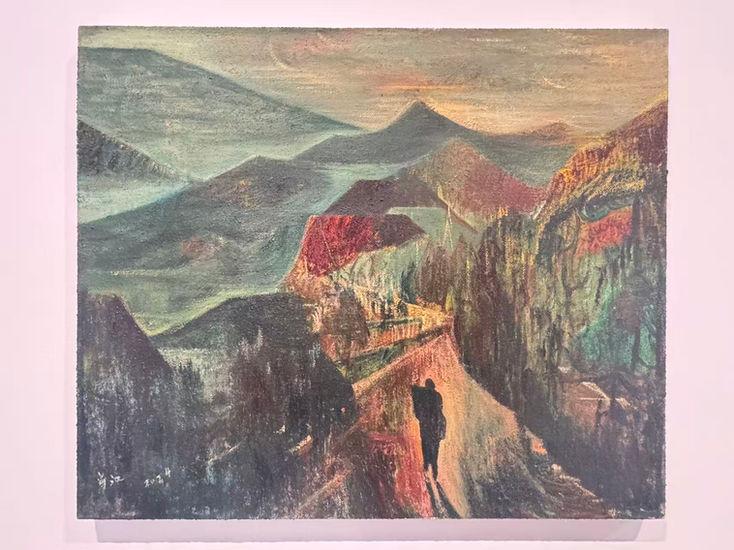
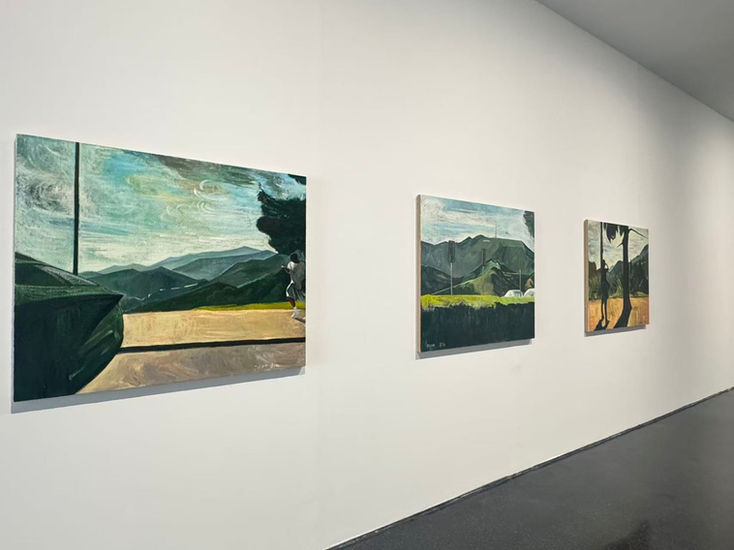
Landscape has long been a central thread in Xiao Jiang's practice. This exhibition extends that thread through a selection of his outdoor paintings. The title "Looking Out" echoes a phrase that often returns to the artist while he works: "The one who looks out at the scenery."
In this body of work, "looking out" becomes the hinge between
figure and landscape—between what lies within the frame and what extends beyond it.
During his stay in the United States earlier this year, he created several works. Compared with earlier distilled mountain scenes shaped from memory and photographs, these landscapes are more specific and immediate, carrying the sensibility of being in nature. For Xiao, they recall a late-afternoon ascent: moving from a city's edge up toward a summit as daylight slips into dusk, wind, light, and terrain shifting in and out of view. Each canvas settles a moment of looking outward—an experience one can revisit.
In the galleries, viewers stand as if shoulder-to-shoulder with the figures in the paintings, sharing a gaze into the distance. Outer scenery and the artist's inner state converge in the same instant, transforming every location into a landscape.




“Cosmic Clock”
Beneath the circular dome of the TANK Shanghai, Jean-Marie Appriou unfolds "Cosmic Clock" as a vast respiration of matter and time. The exhibition takes the form of a living cycle—an astral clock in which each sculpture becomes a sign, a rhythm, a pulse of the universe.
Within the monumental shell of a former oil tank—an architecture born from transformation and flow—Appriou orchestrates a passage between biology and astronomy, mythology and alchemy, and East and West.
Shaped from aluminum, bronze, and blown glass, Appriou's sculptures seem to emerge from a world in metamorphosis. They hover between the vegetal and the mineral, the human and the animal, and the terrestrial and the celestial. Each form breathes as if it is animated by the slow memory of the elements.
At the threshold of this constellation, three works mark the entry point for a journey through origins: The artwork "Vent Horizon (Primordial Soup)" evokes the moment when life first emerged from cosmic matter, suspended between water and sky, dream and substance.
With Vessel of Life, Appriou reimagines the sacred solar barques of ancient Egypt: suspended in space, ribbed like fossilized wood, it carries at its center an androgynous bronze figure—astronaut, watcher, and witness of cosmic passage. In dialogue with Vessel of Time, which was created on the Giza Plateau in 2024 using clay drawn from the Nile, this sculpture extends Appriou's exploration of mythic crossings, ranging from the funerary voyages of pharaohs to the metaphysical journeys of humankind.
At the heart of "Cosmic Clock," the series of Zodiacs unfolds as a terrestrial constellation, a dialogue between Greek, Arabic, and Chinese astrology. Each animal embodies an elemental force, serving as a link between the earthly and the cosmic, as well as the known and the eternal.





Ticket pricing:
A combined ticket for Tang Yongxiang's "People Tree Feet" and Xiao Jiang's "People Looking at the Scenery" costs 50 RMB
The "Cosmic Clock" art exhibition is sold separately, also priced at 50 RMB
Visiting all three exhibitions takes approximately 1.5 hours.


Comments