
STAR Museum
- Cathy Shen

- Dec 30, 2025
- 4 min read
STAR Museum is located at 111 Ruining Road, Xuhui District, Shanghai. The original site was the "Rihui Port Warehouse," the first railway platform for sea-land transfer in modern Chinese history. It was designed by Pritzker Prize laureate Jean Nouvel. The renovation project preserved the industrial heritage features, incorporating a 120-meter riverside viewing platform and an expansive rooftop terrace with river views. The design employs beam-free, high-ceilinged spaces with light and shadow effects, creating a new cultural landmark that combines historical memory with modern functionality.


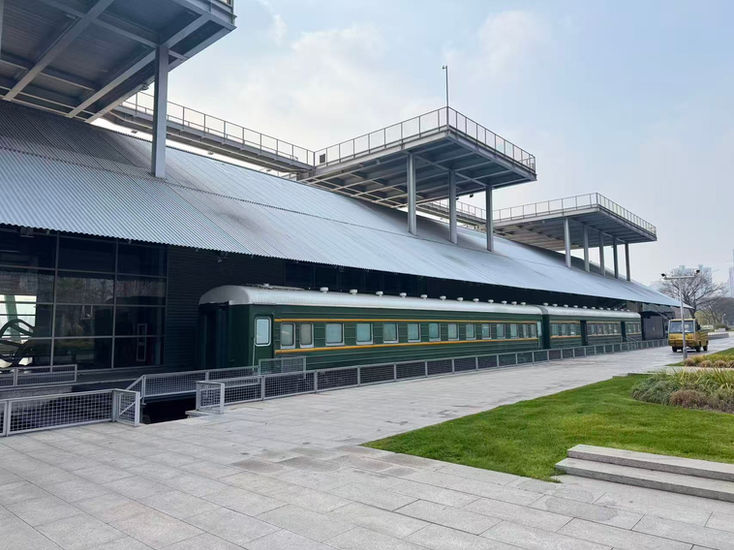
The museum officially opened in 2022 and currently has two themed exhibitions running simultaneously. One is "I Witness Gold-Paved Shanghai" (opened June 29, 2025), and the other is Safwan Dahoul's Solo Exhibition (exhibition period: November 14, 2025, to December 27, 2025). The former is the fourth installment of STAR Museum's opening exhibition series, while the latter is the twentieth edition of STAR Museum's "Genealogy Study of Artists" (Genealogy Study of Artists No. 20).
"I Witness Gold-Paved Shanghai"
The "I Witness Gold-Paved Shanghai" series exhibition is displayed on the first floor and basement level of the exhibition hall. It primarily showcases 35 artworks by contemporary Chinese and international artists, mainly paintings, with some installation art. Each artwork is a unique creation from the artist's distinctive perspective, expressing the creator's understanding, exploration, contemplation, and questioning of society, history, culture, politics, natural forms, art history, and art itself.
As stated in the exhibition brochure, this exhibition has nothing to do with "gold-paved roads"—how to interpret this theme is left entirely to each visitor's own understanding. Fortunately, the curatorial team has prepared a brochure listing brief introductions to each artist and their works for visitors to read.



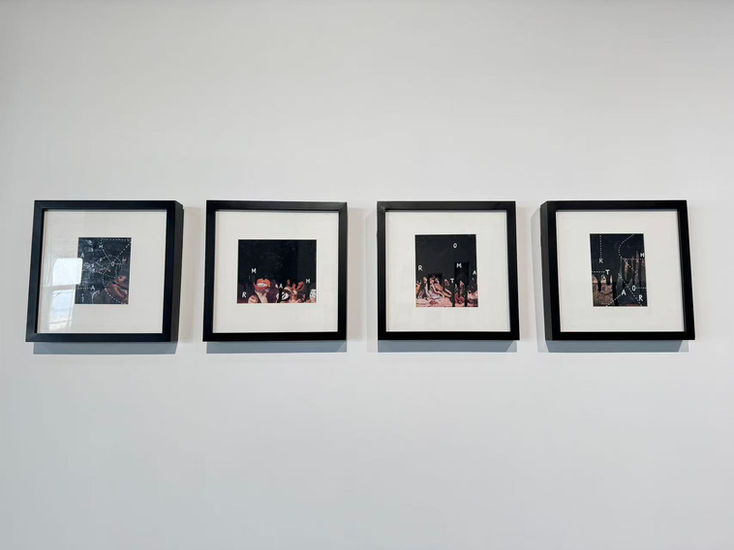






Featured Artwork: I sei Sensi by Alighiero Boetti
Let us appreciate one artwork: I sei Sensi by Italian artist Alighiero Boetti. This painting consists of eleven panels. Italian letters and white symbols are arranged on the panels as if projected onto a Cartesian coordinate system. This graphic format compels viewers to "read" these symbols both horizontally and vertically, experiencing and contemplating their meaning simultaneously.
It is said that this painting is an important expression of Italian "Arte Povera" (Poor Art) and is also one of the artist's representative works.

About Arte Povera (Poor Art)
Arte Povera was an avant-garde art movement that emerged in Italy in the 1960s and became the most influential art movement in post-World War II Europe. The term "Arte Povera" was first coined by Italian critic Germano Celant in 1967, though it never formed a defined group.
Arte Povera primarily consists of sculpture and installation art, opposing the Modernist abstract painting and Minimalist art that dominated Europe in the 1950s. Artists used "poor" materials from everyday life—such as earth, stones, fabric, paper, and horses—focusing on the material properties of these ordinary substances. The movement resisted modernity's erasure of historical memory, reflected critically on mechanical rationalism, advocated a return to nature, broke down the boundaries between art and life, and evoked pre-industrial perceptions and memories of tradition and locality.
Safwan Dahoul Solo Exhibition
The first Asian museum solo exhibition of Syrian-born Middle Eastern artist Safwan Dahoul is displayed on the second floor of STAR Museum. Over 40 works by the artist are exhibited here. The artist excels at using contrasts of light and shadow to create alienated, deformed human figures.
His creative career has been influenced by Picasso's Cubist style, while also incorporating influences from Assyrian Art and Pharaonic Art. At the same time, his work remains highly distinctive and personal in character and style.


Assyrian Art
Assyrian Art refers to the visual arts produced by the Assyrian Empire, one of the most powerful civilizations of the ancient Near East. This art was most popular during the Neo-Assyrian period (911–609 BCE), but Assyrian culture goes back much further, to around 2500 BCE in northern Mesopotamia (now Iraq, Syria, and Turkey).
Assyrian art is renowned for its monumental scale, dramatic narrative scenes, and exquisite relief carvings that decorated the palaces of mighty kings.
Narrative Storytelling: Unlike the static, symbolic nature of Egyptian art, Assyrian art excelled at depicting continuous narratives—sequential scenes showing military campaigns, royal hunts, and religious ceremonies unfolding across palace walls like an ancient graphic novel.
Realism and Detail: Assyrian artists achieved remarkable naturalism, particularly in depicting animals. Lions, horses, and bulls are rendered with extraordinary attention to muscle, fur, and movement. Human figures, while somewhat idealized, show detailed armor, weaponry, and costumes.
Propaganda and Power: Art served as a powerful tool of royal propaganda, glorifying the king's military victories, divine favor, and absolute authority. The imagery was designed to intimidate foreign visitors and inspire awe among subjects.
Monumental Scale: Assyrian rulers commissioned massive architectural projects adorned with colossal sculptures and extensive relief programs covering entire palace walls.
Assyrian art had a profound impact on the visual cultures of Persia, Babylon, and beyond. After the empire's fall in 609 BCE, its artistic traditions influenced the Achaemenid Persian Empire. The rediscovery of Assyrian palaces in the 19th century by archaeologists like Austen Henry Layard captivated the Western world, and major collections now reside in the British Museum, the Louvre, and the Iraq Museum.
Pharaonic Art
Pharaonic Art refers to the visual arts produced in ancient Egypt during the Pharaonic period, spanning roughly from 3100 BCE to 30 BCE—a period of over 3,000 years. This art form is one of the most recognizable and influential in human history, characterized by its distinctive style, symbolic nature, and remarkable consistency across millennia.
Stylistic Conventions: Pharaonic art followed strict rules and conventions that remained largely unchanged for thousands of years. The most important is the "composite view" method of showing the human body, which shows heads in profile, eyes and shoulders from the front, and legs in profile. This technique wasn't due to lack of skill but rather a deliberate choice to show each body part from its most recognizable angle.
Hierarchy of Scale: Figures were sized according to their social importance, not realistic proportions. Pharaohs and gods appear much larger than servants, soldiers, or common people in the same scene.
Symbolism and Function: Nearly every element in Pharaonic art carried symbolic meaning. Colors, poses, and objects all conveyed specific ideas—blue represented the Nile and fertility, gold symbolized divinity, and certain poses indicated power or submission.
General admission to the STAR Museum is 100 RMB, and a visit takes approximately 1 hour.


Comments