
Modern Art Museum Shanghai (Yicang Art Museum)
- Cathy Shen

- Dec 21, 2025
- 4 min read
Modern Art Museum Shanghai (Yicang Art Museum) is located at 4777 Binjiang Avenue, Pudong New District, Shanghai. It is an industrial-style art venue converted from the old coal storage silos of Laibaidou Wharf, focusing on Eastern and Western classical art and contemporary design. The museum's predecessor was Shanghai Port's largest coal loading and unloading terminal in the 1980s. After renovation in 2016, it officially opened in January 2019. The building keeps the famous coal hopper shape and industrial look, blending old and new areas with hanging design features, resulting in special concrete exhibition rooms and a riverside viewing area, covering almost 7,000 square meters. It is positioned as a "diverse, open, and interactive" art complex, encompassing exhibitions, education, cultural creative products, and leisure facilities.


When I visited today, the museum was hosting the contemporary art exhibition "Huang Kui: Stratagems." The exhibition opened on November 2, 2025, and runs until January 30, 2026. It presents nearly 30 "Hard-Paintings" and related video works that the artist has recently devoted himself to creating by merging painting and video media, while also organizing important documentation of the artist's commitment to this transformative body of work.
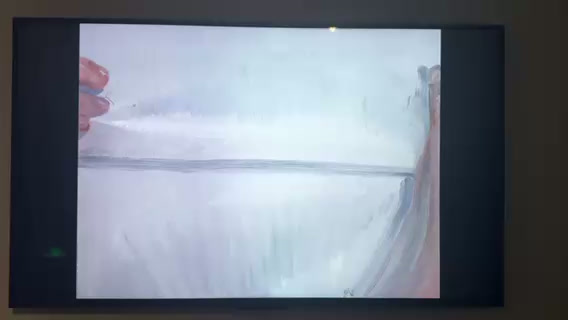
The "Hard-Painting" series that Huang Kui began in 2022 involves labor-intensive work of repeatedly repainting a single canvas and converting it into continuous video imagery—averaging a hundred repaintings, with some reaching up to a thousand. Through this process, Huang Kui continuously incorporates his extensive knowledge of art history, references from film history, and personal visual experiences, all under the same theme, which results in multiple visual epiphanies and allows him to engage with the material-spacetime of painting. He strives to restore the "potential unity of the artwork" as a painting-object in an age of technological acceleration. Over the course of three years, having painted approximately ten thousand still frames in total, Huang Kui has, with astonishing speed and workload, physically comprehended the contemporary painting language that once amazed the post-75 generation of Chinese artists—such as the technical value of erasure, splashing, gestural smearing, and scraping, and their specific semantic expressions in creative practice. Like other Chinese artists who are unhappy with the limitations of traditional painting, Huang Kui constantly changes his images as if he were a restoration expert, directly addressing the complicated issues of the early 21st century and the challenges of personal identity affected by big tech companies. His works explore possible international conflicts, ethical dilemmas caused by technology, and how personal experiences connect with larger historical events, reality, and even the laws of the universe.
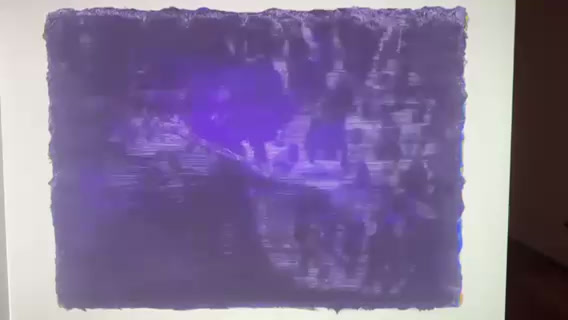
The exhibition is divided into four sections—Corridor, Backstage, Cave, and Documentation—progressively unveiling Huang Kui's "Hard-Painting" practice and the cultural issues it focuses on. In the core exhibition area, "Cave," viewers will watch the painting videos created by the artist over three years while surrounding a giant screen, amid a negative-image cave landscape created from painting brushstroke images magnified a thousand times. Huang Kui discovered that the details of his work share countless dialogic connections with prehistoric painting practices: what humans care about is nothing apart from the self and the encompassing universe. The Corridor section shows Huang Kui's thoughts on how people need to change their way of seeing things in response to our fast-paced, technology-driven world—how we deal with distractions to find our place and react in a time of confusion and cultural change.
In fact, the development of the "Hard-Painting" technique stems from artistic experiments Huang Kui began conducting at the turn of this century. Besides "67 Accidental Self-Portraits" (2008) presented in this exhibition, it is also embodied in his performance work "Does GOD Exist?," which was selected for an independent curatorial project at the 52nd Venice Biennale, and in his early installation series "Stories of Glory." Just as one of the earliest science fiction writers, Tiphaigne de la Roche (1722–1774), prophesied in his work "Giphantie" (1760) that "painting can reveal more truth in continuous motion," Huang Kui once again breaks through the spatial limitations of his earlier creations, using more immersive artistic effects to reveal to us that painting—as an ancient craft as old as fire itself—still possesses irreplaceable, and urgently experimental, cultural power in an age of artificial intelligence abuse.
The above three paragraphs come from the official introduction of this exhibition at the Modern Art Museum Shanghai.
In fact, this method of repeatedly layering oil paint in creation is not rare nowadays. When I visited Tank Shanghai, there were painters using this technique of completely covering previous paintings layer by layer to create artwork. However, Huang Kui has indeed made this approach more meaningful—not only through more layers of coverage, with each layer being a complete work in its own right, but also by making each layer a frame in a video of the artwork. The result is not merely a display of the creative process but a complete narrative. At the same time, this kind of creation is also an experiment: transforming two-dimensional oil paintings into vertical depth through layer upon layer of coverage and then presenting it in "four dimensions" by integrating the images into video. This step makes the viewer's experience richer and allows them to better perceive the thoughts and concepts the artist wishes to express.
Let me take you through two works to provide you a sense of Huang Kui's art.
"Paper Airplane" not only displays the final oil painting—a paper airplane burned to ashes—but also shows the process of folding and burning through painted imagery, compiled into a 42-second video. "The Shape of Time" uses 720 layers of coverage, stacking oil paints of different colors on the canvas while consistently depicting an hour hand. Ultimately, the 720 layers of paint made the work impossible to hang, with the paint peeling and falling off. During the creative process, the hour hands from each layer combine to present a 120-second video: colors stack layer by layer while the hour hand keeps rotating, spinning faster and faster. It is as if in this moment, time has taken on both shape and color.




The entire exhibition tour takes over an hour and costs 30 RMB.
Stepping out of the Modern Art Museum Shanghai, you're right at the Huangpu River. Sipping coffee at the first-floor café while reflecting on the exhibition and watching the boats pass by is quite a delightful experience.


Comments