
Long Museum West Bund
- Cathy Shen

- Nov 8, 2025
- 5 min read
Long Museum West Bund is located at 3398 Longteng Avenue, Xuhui District, Shanghai. The Long Museum (West Bund) is situated at the former Beipiao (北票) Wharf site, founded by renowned art collectors Liu Yiqian and his wife, Wang Wei. Designed by China's top architect, Liu Yichun (Atelier Deshaus), the museum has a total construction area of approximately 33,000 square meters and opened in 2014.
The main building features a distinctive "umbrella vault" structure as its architectural characteristic, comprising four floors (two above ground and two underground). The large-scale cantilevered vaulted spaces above ground are formed from finely textured fair-faced concrete, creating a visual dialogue with the fashionable "Hopper Gallery" space—transformed from the original Beipiao (北票) Wharf's "coal hopper" structure. This creates a sensible and peaceful industrial feel, highlighting a strong contrast between heaviness and lightness, while giving the museum a modern and creative look.


During my visit, Long Museum West Bund featured three thematic exhibitions: Chen Yujun's solo exhibition "I, We," the special exhibition "Clay Charm and Ink Fragrance" featuring paintings and Yixing purple clay by modern and contemporary Chinese painting masters, and the "Shape of Spirituality" special exhibition for the Year of the Snake. The first exhibition was in the West Building gallery, while the latter two were on the museum's B1 floor.
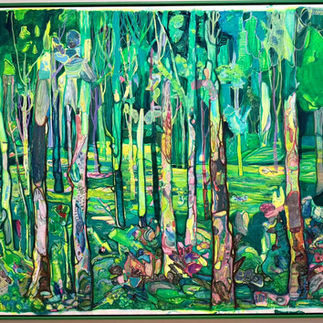
Chen Yujun Solo Exhibition "I, We"
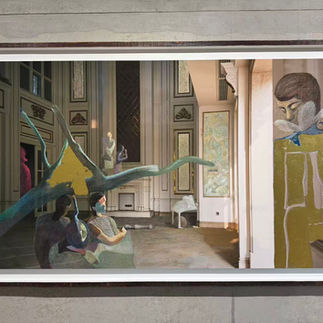
Chen Yujun is a Chinese artist from Fujian Province, born in 1976 in Putian, Fujian, and currently living and working in Shanghai. His creative work integrates individual experiences with globalization, exploring regional culture and the interaction between individual life and environment through painting, installation, and other media. Chen Yujun's paintings focus on space; since his work "Asian Territory" in 2009, the depiction of spaces and interior scenes has become a recurring motif in his later pieces. The exhibition runs from October 10, 2025, to January 4, 2026.
In 2020, Chen Yujun was stuck in Hengdian, Zhejiang, during the pandemic. During those long three months, he had the chance to visit the most luxurious villa district in the area with a friend. One villa, known as the "Building King," particularly moved Chen Yujun. It was half-renovated but had already stopped construction. The abandoned site was like a slice of an era's development, preserving people's recent imaginations of family, aesthetics, and a better life. This feeling was reflected against another occurrence: once American style, French style, and Tuscan style spread across China's streets—it was witness to an era's spatial desire for modernization and internationalization, representing people's distant horizons and dreamed foreign lands, becoming the initial real-world inspiration for the "Outsider" series. This solo exhibition showcases works from the "Outsider" series, another excellent series where Chen Yujun explores and transcends through spatial depiction.






"Clay Charm and Ink "Fragrance"—Special Exhibition of Paintings and Purple Clay by Modern and Contemporary Chinese Painting Masters
This exhibition centrally displays masterpieces of calligraphy and painting by twentieth-century Chinese painting giants, including Zhang Daqian, Li Ruochan, Huang Yongyu, Tang Yun, Lu Yanshao, Fu Baoshi, Pan Tianshou, Bai Xueshi, Xie Zhiliu, and Chen Peiqiu. Works such as Wu Changshuo's "Orchids, Rocks, Wind, and Bamboo," Qi Baishi's "Wild Interest of the Lotus Pond," Xu Beihong's "Twin Horses," Zhang Daqian's "Wild Interest of the Lotus Pond," Huang Yongyu's "Morning Dew," Pan Tianshou's "Vigorous Pine," Wu Guanzhong's "Lotus Pond," Lin Fengmian's "Pine Waves," Fu Baoshi's "Light Boat Night Journey," and Chen Peiqiu's "White Lotus," among others, left me—as a Chinese painting enthusiast—overwhelmed with visual delight.
What's even more remarkable is that the exhibition also features collaborative works between these masters and contemporary Yixing purple clay pot artisans from their early years, showcasing creations where they wielded their brushes directly on purple clay teapots. When master clay sculptors met with calligraphy and painting masters, the purple jade and golden sand transformed into flowing Xuan paper (宣纸), creating countless legendary stories in the roaring kiln fires. Their work allows viewers to appreciate the painters' artistic style while glimpsing the universe within the teapots—a feast for the eyes. The exhibition runs from October 1, 2025, to March 1, 2026.
In this exhibition, all displayed Chinese paintings are classified into three categories: "ink and color on paper" (纸本设色), "ink on paper" (纸本水墨), and "ink and color on silk" (绢本设色). Let's understand these three types of Chinese painting.


"Ink and Color on Paper," "Ink on Paper," and "Ink and Color on Silk"
"Ink and color on paper" is an important form of traditional Chinese painting, composed of two core elements: "color application" and "paper base." "Color application" refers to the creative technique of applying pigments, distinct from pure ink techniques, expressing the formal characteristics and situational changes of objects through color layering. "Paper base" specifically refers to Xuan paper as the base material, creating a material distinction from fabric-based supports like silk and damask. This painting style can keep the qualities of Xuan paper, like how it absorbs and spreads ink, while also showing beautiful effects with layers of color, making it a popular choice for detailed heavy-color paintings and light crimson landscape paintings.
"Ink on paper" refers to ink paintings created on Xuan paper, one of the forms of Chinese painting expression. In contrast to "ink and color on paper," this form uses water and ink as the primary media, emphasizing Xuan paper as the carrier, presenting an interactive characteristic between the uncontrollable and controllable aspects that arise spontaneously. Compared to "silk base," its painting support is Xuan paper rather than silk fabric.
"Ink and color on silk" refers to artistic works painted with colored pigments on silk fabrics, such as silk, damask, and other silk textiles. Its technique includes two main parts: the silk base is the use of silk fabric for the painting, which often shows unique patterns because of the fibers; color application focuses on how colors spread using traditional Chinese painting pigments, making it different from just using ink.
Yixing Purple Clay
Yixing purple clay is a specialty product of Yixing City, Wuxi, Jiangsu Province, and a Chinese National Geographical Indication product.
Yixing purple clay ware (teapots) are uniquely Chinese handcrafted ceramic art pieces. Made from purple clay as raw material, they originate from Dingshu Town in Yixing, Jiangsu, hence the name. With rising prices in the auction market, these are collectible "antiques," with works by famous masters often being extremely difficult to acquire—as the saying goes, "Why seek earthly jewels when Yixing purple clay is most precious?" It is said that the founder of purple clay teapots was Gongchun from China's Ming Dynasty. The perfect combination of artistry and practicality makes purple clay teapots so precious and endlessly captivating. Furthermore, the benefits of brewing tea in purple clay teapots, combined with the culture of tea and Zen as one, add to the noble and refined elegance of purple clay.
"Shape of Spirituality" Special Exhibition for the Year of the Snake
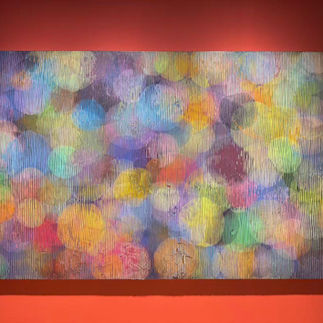
2025 is the lunar Year of the Snake (乙巳). Snakes hold important positions and rich meanings in cultures worldwide. People admire the snake's sinuous and unique life posture, fear its danger, yet worship the power of rebirth symbolized by its skin-shedding. This special exhibition features over thirty abstract artworks, all taking natural mountains and forests as their subject matter, visually relating to snake imagery and other biological forms. The artists share their ideas using lines and shapes—some focus on the textures and patterns found in nature, some think about biological shapes and structures, while others highlight movement and energy by using different materials together.




The combined ticket for all three thematic exhibitions costs 100 RMB, and viewing all of them takes approximately 2 hours.


Comments