

As the first stop on "Collision and Fusion," the on-campus exhibition allowed us to create an art exhibition and related activities from scratch. We discussed and formulated the exhibition plan and on-site layout; wrote the art exhibition foreword, interactive Q&A, and presentation slides; designed and produced display boards and posters; rented professional art exhibition stands; and custom-ordered picture frames.
Unexpected surprises kept emerging: for example, I chose 1m×2m black metal display stands, so I printed all the digital paintings in the standard 4K size, which is a standard painting dimension. However, the readily available picture frames on the market were all 38×53 cm, which was smaller than the standard 4K size, requiring us to trim the printed laminated poster paper slightly. Additionally, the metal picture frames with compliant hanging hardware needed to be disassembled for mounting the artwork, turning what sounded like a simple framing task into work that required both technical skills and considerable physical effort.
However, despite being tired, we were happy, and our art exhibition successfully launched on schedule!
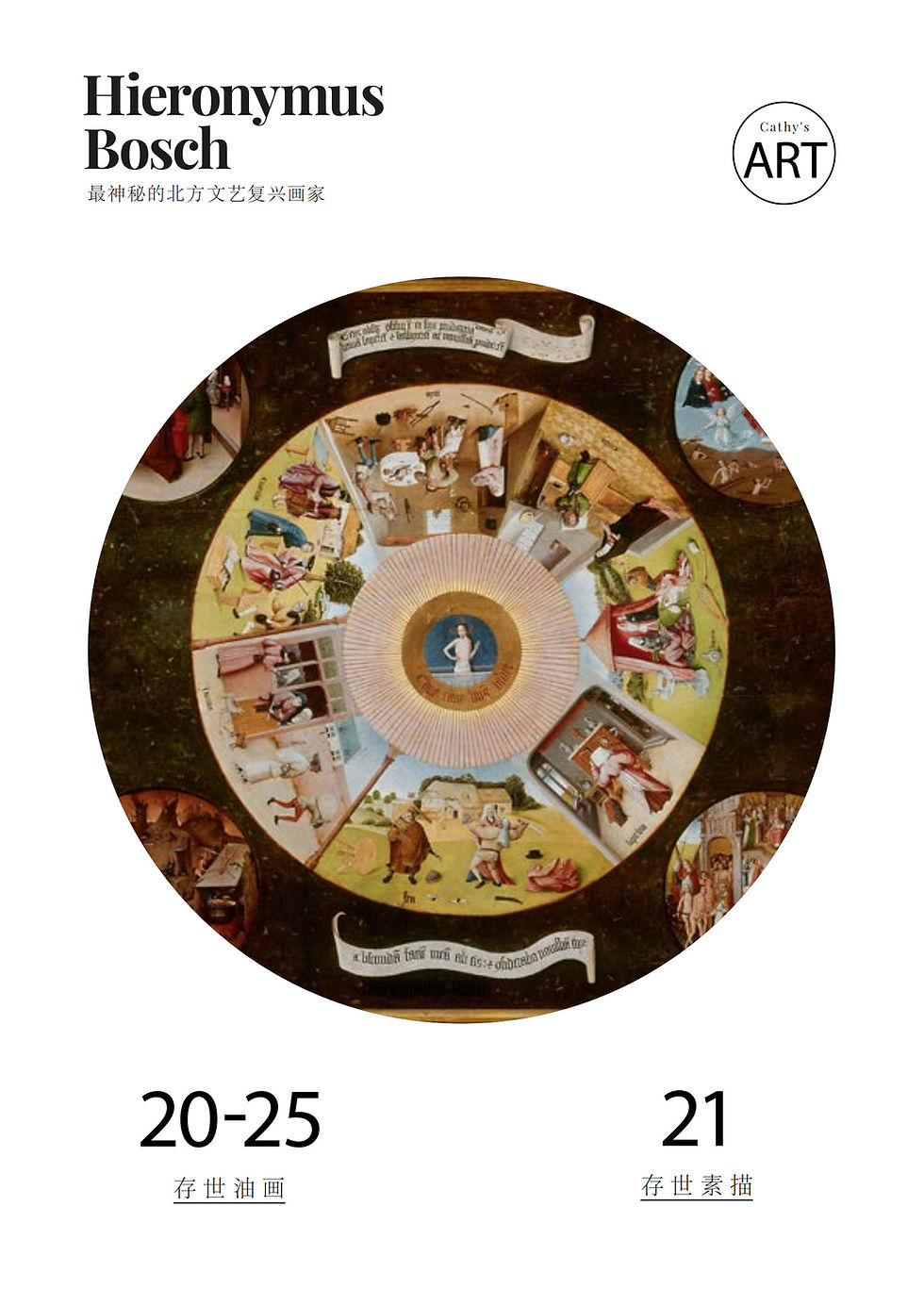
Moreover, we hoped it would be more than just a simple art show—we wanted it to be a platform for artistic exchange and interaction. To achieve this, we designed a quiz session with prizes to engage our visitors. We also organized students who enjoy digital illustration to participate in a fun "illustration relay" game on-site. Each participant was responsible for drawing one layer, working together to collaboratively design a mascot for our club. As someone who admires the Dutch painter Bosch, I created a small booklet using InDesign, which we learned in Art & Design class, and distributed it to visitors to introduce my "idol."

Eshibition Preface
Time fractures here, only to be reborn elsewhere.
When Van Gogh's starry night vortex encounters cyberpunk neon, when the flowing robes of Dunhuang's celestial dancers descend into the interwoven light and shadow of digital matrices, we stand at an unprecedented threshold—here, the classical is no longer frozen eternity but a fluid present continuous.
"Collision and Fusion" is not merely an exhibition but a manifesto of aesthetic revolution. We refuse to imprison art within museum vitrines and refuse to let classics become entombed dogma. In this experimental space, the light and dark techniques from the Renaissance mix with art created by algorithms, and the Eastern idea of empty space works together with Western simplicity on the same canvas. Each encounter of brushstrokes is a dialogue between civilizations, each fusion of colors a reconstruction of spacetime.
Art history is not an epitaph but living DNA.
Participants analyze the classics with deconstructionist audacity and subsequently reconstruct the fragments with postmodernist insight. They are not imitating but translating—transcoding Da Vinci's cipher into contemporary visual vernacular, re-encoding Monet's luminous impressionism into pixelated digital psalms. This procedure is an intertextual creative practice, where each work becomes a dual symphony of homage and rebellion against art history.
We deliberately blur the boundaries between creator and viewer in this decentralized artistic field. The exhibition space is no longer a unidirectional apparatus of the gaze but a participatory aesthetic laboratory. We invite every visitor to become a co-conspirator in creation, to redefine what constitutes "classic" through their lens, and to touch the temperature of art with their hands. Only when art sheds its sacred aura does it truly begin to breathe.
This project is a movement for the democratization of aesthetics.
From canvas to screen, from sculpture to installation, from static to kinetic, from material to virtual—we witness the metamorphosis and renaissance of artistic forms. Commodification is no longer art's degradation but another manifestation of its vitality. When design descends from its pedestal, when creation merges with the quotidian, art fulfills its ultimate mission: to become life itself.
The inaugural voice of "Art and Beyond" chooses the most radical yet tender approach—to return art to the realm of humanity. The exhibition seeks resonant frequencies through collision and explores the aesthetics of difference in fusion. This exhibition is not merely a visual feast but a social experiment in the democratization of art, the popularization of knowledge, and the quotidianization of creation.
Welcome to the place where boundaries dissolve.
Here, you are simultaneously observer and observed, interpreter and interpreted text. Each gaze rewrites art history; each creation expands the territory of beauty.
Together, let us ignite sparks in collision and nurture new life in fusion.
I. Add details into the curatorial plan to adapt to the campus exhibition
Exhibition Setup Planning
Setup Start Time: After 14:10 on December 12, 2025
Location: Third floor atrium of the teaching building
Main Facilities: There are approximately 12 gate-type display stands (floor-standing folding screen stands) measuring 100 cm × 200 cm each, and both the front and back sides of these display stands must be used for the exhibition. Additionally, adequate space must be reserved for visitors during the setup. One roll-up banner will be used for the exhibition foreword and introduction, or it can be converted into display boards to be placed on the stands. Equipment needs to be moved in and installed on rest days in advance, without involving any school building facilities (walls, floors, etc.). Display stand arrangement will be rationally designed based on the exhibition hall structure, with a preliminary plan for a "herringbone" zigzag arrangement that will not affect corridor or other passage spaces.
Setup Personnel: All club members
Supporting Activities (Tentative)
-
Morning Assembly Presentation (involving 8th and 9th grades);
-
"One Person, One Stroke" Activity—On-site invitation for students to freely draw on blank canvases (blank canvases will be fixed on display stands, with paints, brushes and other materials provided only during the activity), ultimately forming a special "graffiti painting," once per semester, eventually compiled into a collection;
-
Based on "art classics" referenced in the exhibition, there will be an on-site Q&A session with winners receiving club cultural creative merchandise or a custom painting on-site (custom paintings completed on-site by club members according to requirements).
-
Conduct a "My Favorite Artwork" voting activity.
II. Design the invitation poster

III. Design and make the exhibition board

Primary Exhibition Board (4 m × 2 m)

Secondary Exhibition Board (4 m × 2 m)
IV. Prepare some entry-level art history Q&A questions to be used as a question bank for prize quizzes during on-site promotional activities
Western Art History Section
-
Which museum currently houses Leonardo da Vinci's "Mona Lisa"?
Answer: The Louvre Museum in Paris, France -
In which country did the Renaissance movement originate?
Answer: Italy -
Who created the "David" statue, and what material was used?
Answer: Created by Michelangelo; made from marble -
Which Post-Impressionist painter is known for the "Sunflowers" series?
Answer: Vincent van Gogh -
Who was the sculptor of "The Thinker"?
Answer: Auguste Rodin -
What was Monet's favorite flower to paint? He planted large quantities of these in his garden.
Answer: Water lilies -
Which country was Rembrandt from, and what type of works was he most skilled at painting?
Answer: The Netherlands; portraits and self-portraits -
What are Raphael, Leonardo da Vinci, and Michelangelo collectively known as?
Answer: The Three Masters of the Renaissance -
What scene does Van Gogh's most famous work, "The Starry Night," depict?
Answer: A night sky featuring swirling clouds, bright stars, a crescent moon, and a village landscape -
What is the most famous scene Michelangelo painted on the ceiling of the Sistine Chapel?
Answer: "The Creation of Adam" (the scene of God giving life to Adam) -
The name "Impressionism" originated from the painting "Impression, Sunrise" by Claude Monet.
Answer: Monet's "Impression, Sunrise" -
What art movement did Picasso represent?
Answer: Cubism -
What religious story does "The Last Supper" depict?
Answer: The scene of Jesus dining with his twelve disciples for the last time, prophesying that someone would betray him
Chinese Art History Section
-
What are the three major categories of Chinese painting based on subject matter?
Answer: Figure painting, landscape painting, and bird-and-flower painting -
What is the most famous calligraphy work by Wang Xizhi, the "Sage of Calligraphy"?
Answer: "Preface to the Orchid Pavilion" (Lanting Xu) -
Who was the artist of "Along the River During the Qingming Festival," and which dynasty's life scenes does it depict?
Answer: Created by Zhang Zeduan; depicts life scenes from the Northern Song capital Bianjing (modern-day Kaifeng) -
In which dynasty did blue and white porcelain reach its peak? What colors were mainly used?
Answer: Ming and Qing dynasties (especially the Ming Dynasty); blue and white colors -
What are the five main styles of Chinese calligraphy?
Answer: Seal script, clerical script, regular script, running script, and cursive script -
What art form are the Dunhuang Mogao Caves famous for?
Answer: Buddhist murals and painted sculptures -
In traditional Chinese painting, what three plants are referred to as the "Three Friends of Winter"?
Answer: Pine, bamboo, and plum
Basic Art Knowledge
-
What are the three primary colors in painting?
Answer: Red, yellow, and blue (pigment primary colors) -
What are the two main types of sculpture?
Answer: Sculpture in the round and relief sculpture -
What is "perspective," and what is its function in painting?
Answer: Perspective is a method of representing three-dimensional space on a flat surface; its function is to create depth and three-dimensionality in paintings, making two-dimensional images appear three-dimensional
Architectural Art
-
What was the original purpose of the Egyptian pyramids?
Answer: Tombs for pharaohs -
What is another name for the Forbidden City, and which two dynasties used it as their palace?
Answer: The Purple Forbidden City; Ming and Qing dynasties -
In which country is the Leaning Tower of Pisa located, and why does it lean?
Answer: Italy, due to uneven ground settlement -
What are the typical features of Gothic architecture?
Answer: Pointed arches, flying buttresses, tall spires, and large stained glass windows -
Which is the most famous Gothic cathedral in France?
Answer: Notre-Dame de Paris -
In ancient Chinese architecture, what did roof colors typically represent? What rank did yellow glazed tiles signify?
Answer: Roof colors represented the building's rank; yellow glazed tiles represented imperial buildings, the highest rank
Modern Art
-
Andy Warhol's "Marilyn Monroe" belongs to which art movement?
Answer: Pop Art -
In approximately which century was photography invented?
Answer: 19th century (officially announced in 1839) -
Street graffiti art originated in which city of which country?
Answer: New York, United States
V. Create special exhibition labels for explaining creative concepts and analyzing artistic comparisons


Special Exhibition Label (38cm*53cm)
VI. The majority of artworks we collect are digital illustrations, which we print and frame uniformly


Painting Frame (38cm*53cm)
VII. I designed a booklet to introduce Hieronymus Bosch


VIII. Exhibition installation
Friday, December 12, 2025—after school, we installed our campus art exhibition. Three hours of dedicated effort, repositioning frames again and again, all with one goal: to showcase our artistic creations at their best, allowing every visitor to savor each moment they stop to appreciate our work.


IX. Trivia contest with prizes and "My Favorite Artwork" voting
From December 22 to 24, 2025, we held an art history trivia contest with prizes and a "My Favorite Artwork" voting event at the campus art exhibition. The activities took place at noon each day and attracted nearly two hundred students in total to participate and vote. Everyone's enthusiastic participation quickly depleted the prizes we had prepared. Thanks to our fellow student Scarlett for generously sponsoring some snacks, so our winners didn't have to leave empty-handed! Let's take a look at some photos from the event.
As for the most popular artworks, please visit the "Selected Exhibited Pieces" page to view the details.


